

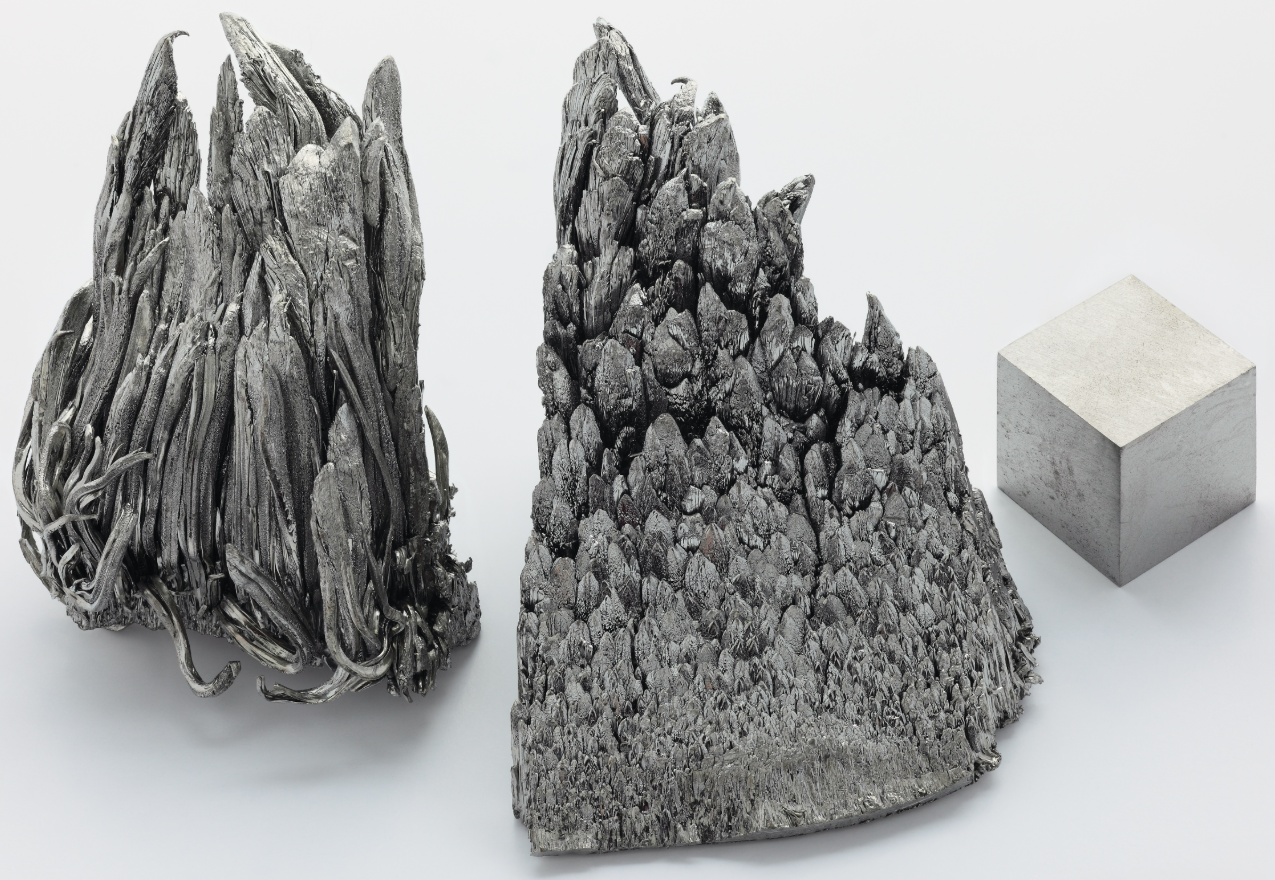
Yttrium (Y, atomic number 39), a silvery-metallic transition metal in group 3 (below scandium and above lutetium), is the namesake of the entire yttrium group and one of the most strategically important rare-earth elements despite not technically being a lanthanide. Discovered in 1794 by Johan Gadolin in the mineral gadolinite (from Ytterby, Sweden—the village that gave its name to yttrium, ytterbium, terbium, and erbium), yttrium was isolated as the metal in 1828 by Friedrich Wöhler. Though chemically similar to the lanthanides (due to similar ionic radius and +3 oxidation state), yttrium often behaves as a “pseudo-lanthanide” and is separated with them in mining and refining.
Abundant in Earth’s crust (~30 ppm, more common than lead or tin), yttrium is never found free and is extracted mainly from bastnäsite, monazite, and xenotime. Its low toxicity, high melting point, and unique electronic properties make it indispensable in high-tech, clean energy, and defense applications.
1. Hidden Features: High Melting Point, Phosphor Magic, and Superconductor Enabler
Yttrium’s electron configuration [Kr] 4d¹ 5s² gives it classic group-3 transition-metal traits with lanthanide-like chemistry.
- High Melting Point & Thermal Stability Yttrium melts at 1526 °C and boils at ~3345 °C—higher than titanium or most steels—making it suitable for high-temperature alloys and ceramics. Its oxide Y₂O₃ is extremely refractory (melting point ~2425 °C) and chemically stable.
- Phosphor & Laser Host Supremacy Yttrium aluminum garnet (YAG, Y₃Al₅O₁₂) doped with rare-earth ions (especially Nd:YAG) is the workhorse solid-state laser crystal—emitting at 1064 nm for industrial cutting, welding, medical procedures (eye surgery, tattoo removal), and military rangefinders. Europium-doped yttrium oxide (Y₂O₃:Eu³⁺) and yttrium vanadate (YVO₄:Eu³⁺) produce the vivid red phosphors in CRT televisions, fluorescent lamps, and LED backlights.
- Superconductivity Pioneer Yttrium barium copper oxide (YBa₂Cu₃O₇, “YBCO”) was the first material discovered (1987) to superconduct above liquid-nitrogen temperature (critical temperature ~93 K). YBCO remains the benchmark high-temperature superconductor for power cables, magnets, motors, and levitating trains (maglev).
- Stabilizer in Zirconia & Alloys Yttria-stabilized zirconia (YSZ, typically 3–8 mol% Y₂O₃) prevents phase transitions in zirconia, creating tough, crack-resistant ceramics used in:
- Dental crowns and hip implants
- Solid oxide fuel cells (SOFC) electrolytes
- Thermal barrier coatings on jet turbine blades
- Nuclear & Optical Properties Yttrium-90 (beta emitter, half-life 64 hours) is widely used in targeted radionuclide therapy (radioembolization for liver cancer via SIR-Spheres or TheraSphere microspheres). Yttrium’s low neutron absorption cross-section makes it useful in nuclear control rods and reactor components.
2. Covert Uses: Clean Energy, Defense, Medical, and High-Tech
Global yttrium demand (~10,000–12,000 tonnes/year as oxide/metal) is driven by clean-tech and defense growth.
- Permanent Magnets & EVs Yttrium is alloyed in some high-temperature samarium-cobalt magnets and used in stabilizing neodymium-iron-boron (NdFeB) magnets against demagnetization at high temperatures—critical for EV motors, wind turbines, and military actuators.
- Solid Oxide Fuel Cells & Hydrogen Economy YSZ electrolytes enable efficient, high-temperature SOFCs for stationary power, auxiliary power units, and potential hydrogen production/integration.
- Defense & Aerospace Yttria-stabilized zirconia thermal barrier coatings protect turbine blades in fighter jets (F-35, F-22) and hypersonic vehicles from extreme heat. Yttrium aluminum garnet (YAG) lasers power directed-energy weapons and precision targeting.
- Medical & Cancer Therapy Y-90 radioembolization delivers targeted beta radiation to liver tumors via microspheres—improving survival in hepatocellular carcinoma. Yttrium compounds are explored in cancer imaging and drug delivery.
- Phosphors & Displays Yttrium-based red phosphors remain essential in LED lighting, displays, and anti-counterfeiting inks despite shifts to narrow-band phosphors.
In summary, yttrium isn’t just another rare earth—it’s the quiet gatekeeper that stabilizes ceramics at furnace temperatures, powers the world’s most efficient lasers, enables liquid-nitrogen superconductivity, and quietly supports the clean-energy and defense revolutions.
What’s your favorite yttrium application—the Nd:YAG laser in surgery, YBCO superconductors, or its role in keeping jet engines from melting? Drop it below!