

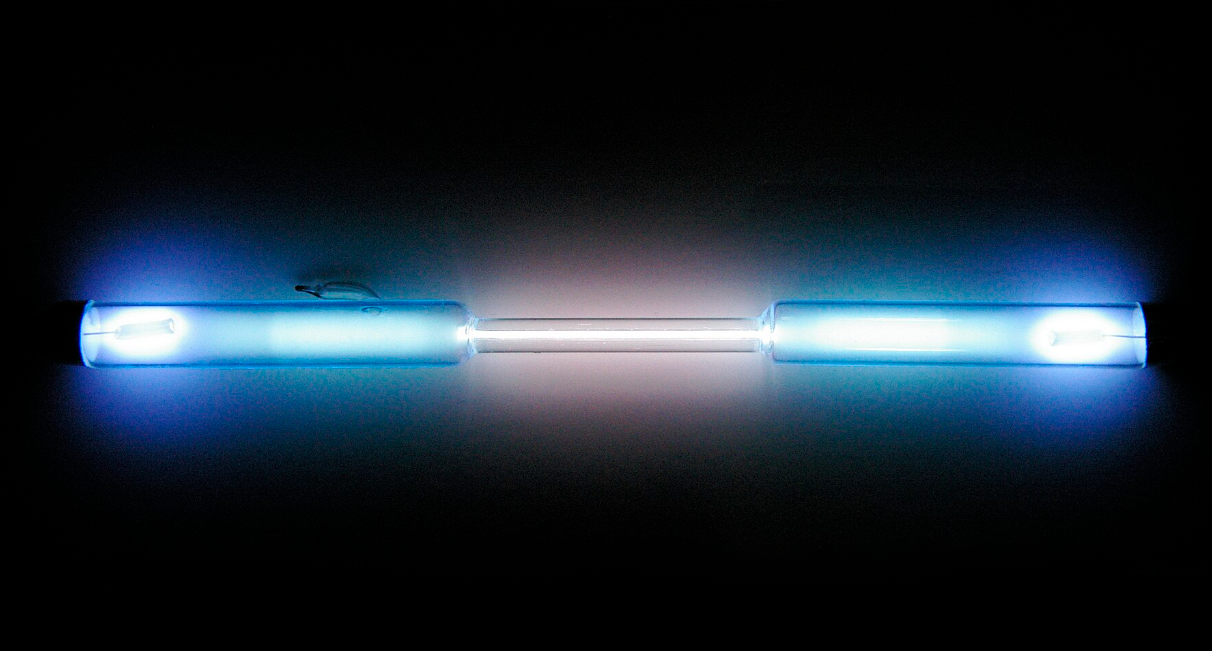
Krypton (Kr, atomic number 36), a colorless, odorless, tasteless noble gas in group 18 (the noble gases), is one of the rarer constituents of Earth’s atmosphere (~1.14 ppm by volume). Discovered in 1898 by Sir William Ramsay and Morris Travers during their systematic fractionation of liquid air—shortly after argon and before xenon—it was named from the Greek kryptos meaning “hidden,” reflecting its elusive presence. While best known to the public as Superman’s home planet, real krypton is a quiet, chemically inert element with profound hidden features in lighting, lasers, medical imaging, and even planetary science.
1. Hidden Features: Excited-State Brilliance, Isotopic Fingerprints, and Relativistic Stability
Krypton’s electron configuration [Ar] 3d¹⁰ 4s² 4p⁶ gives it a perfectly filled octet—making it chemically inert under normal conditions, though extreme conditions (e.g., high pressure, fluorine compounds) have produced a few exotic KrF₂ and KrF⁺ species.
- Spectacular Emission Spectrum When excited by electric discharge, krypton emits a brilliant white-greenish light rich in spectral lines across visible wavelengths—especially strong in the green (557 nm) and violet regions. This made early krypton-filled bulbs appear whiter and more natural than argon or neon, powering the “full-spectrum” lighting trend of the mid-20th century.
- Krypton-85 – The Radioactive Tracer Kr-85 (half-life 10.76 years, beta decay) is produced in nuclear fission and released during spent fuel reprocessing. Its atmospheric concentration serves as a global tracer for nuclear activities—monitored by the Comprehensive Nuclear-Test-Ban Treaty Organization (CTBTO) to detect clandestine reprocessing or weapons tests. Background levels rose sharply after atmospheric nuclear testing in the 1950s–1960s, then declined after the 1963 Partial Test Ban Treaty.
- Isotopic Cosmochemistry Krypton isotopes (⁷⁸Kr to ⁸⁶Kr, five stable) are powerful tracers in planetary science. Excess ⁸³Kr and ⁸⁶Kr in meteorites and lunar samples reveal cosmic-ray exposure ages; krypton trapped in Martian meteorites (e.g., ALH 84001) helped confirm an extraterrestrial origin. Solar wind-implanted krypton in lunar regolith provides clues to the Sun’s composition over billions of years.
- High-Pressure Phases & Metallization Under extreme pressure (~3.5–5 GPa), solid krypton transitions through several crystalline phases (fcc → hcp → other structures). At even higher pressures (~ hundreds of GPa), theory predicts metallic krypton with potential superconductivity—though experimental confirmation remains challenging.
- Laser & Lighting Dominance Krypton lasers emit at 647 nm (red), 568 nm (yellow-green), and 531 nm (green)—used in eye surgery (retinal photocoagulation), holography, and entertainment lighting before diode lasers largely supplanted them.
2. Covert Uses: Airport Runway Lights, Medical Imaging, and Nuclear Monitoring
Global krypton production is small (~ tens of tonnes/year), extracted as a by-product of large-scale air separation for oxygen/nitrogen.
- High-Intensity Airport & Runway Lighting Krypton-filled bulbs (often mixed with xenon) produce bright, white light with excellent color rendering—used in precision approach path indicator (PAPI) lights, runway edge lights, and threshold bars at airports worldwide. Their long life and resistance to vibration make them reliable in harsh conditions.
- Krypton-81m in Pulmonary Ventilation Imaging Kr-81m (half-life 13 seconds, gamma emitter) is generated on-site from Rb-81/Kr-81m generators and inhaled for lung ventilation scintigraphy—providing real-time images of air distribution in the lungs with extremely low radiation dose due to its ultra-short half-life.
- Double Beta Decay Experiments Kr-78 and Kr-82 are targets in searches for neutrinoless double beta decay (e.g., experiments like EXO-200 and nEXO use xenon but study krypton backgrounds). Detecting this rare process would prove neutrinos are their own antiparticles and help determine neutrino mass.
- Specialty Lighting & Lasers (Legacy & Niche) Krypton flashlamps pumped early ruby lasers; krypton ion lasers powered high-resolution spectroscopy, forensic document examination, and laser light shows before solid-state and diode alternatives took over.
In summary, krypton isn’t just Superman’s lost world—it’s the noble gas that lights airport runways in fog, maps lung function with vanishingly short-lived radiation, silently monitors global nuclear activity through its radioactive isotope, and reveals cosmic histories locked in meteorites and lunar soil.
What’s your favorite krypton fact—the airport lights, its role in nuclear monitoring, or just the sheer irony of a “hidden” element being named for hiding? Drop it below!