

Hydrogen (H, atomic number 1), the lightest and most abundant element in the universe (~75% of all baryonic matter by mass), is the elemental foundation of everything we know. It forms the vast majority of stars, powers fusion in the Sun, and combines to make water—the solvent of life. Yet this simplest atom (one proton, one electron in its ground state) hides astonishing complexity: from quantum weirdness at absolute zero to explosive reactivity, extreme states under pressure, and roles in technologies that could reshape civilization. Discovered in 1766 by Henry Cavendish (who called it “inflammable air”), hydrogen is both the most studied element and one of the most enigmatic in its behavior across scales.
1. Hidden Features: Quantum Simplicity, Extreme Phases, and Dual Nature
Hydrogen’s single electron makes it the ideal testbed for quantum mechanics, yet it reveals surprises at every extreme.
- Quantum Ground State & Isotopes: Protium (¹H) dominates (>99.98%), deuterium (²H or D, 0.0156%) is key in heavy water and fusion research, tritium (³H) is radioactive (half-life 12.32 years) and produced in reactors/cosmic rays. Hidden gem: Ortho- and para-hydrogen—differing nuclear spin alignments—have vastly different physical properties at low temperatures (ortho converts slowly to para, releasing heat that complicates cryogenic storage).
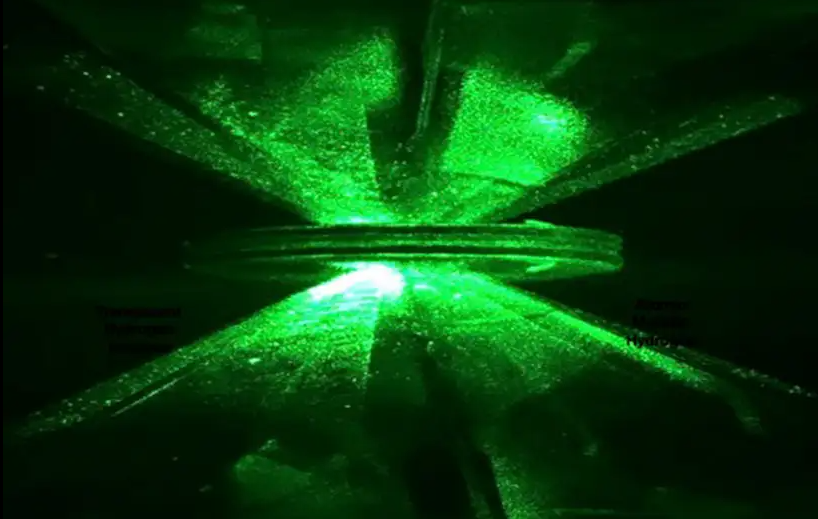
- Metallic Hydrogen – The Holy Grail: Under extreme pressure (~400–500 GPa, conditions found in Jupiter’s core), theory predicts hydrogen becomes metallic—conducting electricity like copper while remaining a quantum fluid. Recent diamond-anvil cell experiments (2017 Harvard claim, heavily debated; ongoing 2020s work at many labs) suggest possible room-temperature superconductivity in compressed hydrides (e.g., LaH₁₀, YH₉, H₃S at ~203 K under 155 GPa). If stabilized, metallic hydrogen could enable lossless power grids and maglev on steroids.
- Plasma & Fusion Fuel: Hydrogen (or deuterium-tritium) plasmas reach millions of degrees in stars and tokamaks. Its low mass and simple nucleus make it the ideal fusion fuel—D+T → ⁴He + n + 17.6 MeV—the most studied reaction for controlled fusion (ITER, NIF, private ventures like Commonwealth Fusion Systems).
- Acidity & Superacids: Neutral hydrogen gas is inert, but the H⁺ ion (proton) is extraordinarily reactive. In superacid media (e.g., HF-SbF₅), protons exist as H₃⁺ or even H₂⁺ clusters, enabling exotic chemistry like stable carbocations and protonated noble gases.
- Interstellar & Primordial Chemistry: Molecular hydrogen (H₂) dominates cool interstellar clouds, cooling gas via quadrupole radiation and enabling star formation. The 21 cm hyperfine line of neutral hydrogen maps galaxies and the cosmic web.
2. Covert Uses: From Bombs to Green Energy and Beyond
Hydrogen’s low profile in everyday life masks its outsized influence in energy, industry, and defense.
- The Hydrogen Economy (Green, Blue, Gray): Steam methane reforming produces ~95% of today’s H₂ (gray), but electrolysis with renewables (green) is scaling rapidly. Covert driver: Hydrogen enables long-duration energy storage, heavy transport (trucks, ships, aviation), and decarbonization of steel/chemicals (direct reduction of iron ore, ammonia synthesis via Haber-Bosch).
- Rocket Fuel (LH₂/LOX): Liquid hydrogen + liquid oxygen powers most large rockets (Space Shuttle main engines, SLS, Ariane 5, many Falcon 9 upper stages, Blue Origin’s BE-4). Its high specific impulse (~450 s) comes from low molecular weight exhaust (mostly water).
- Nuclear Fusion & Weapons Legacy: Deuterium and tritium fueled the first H-bomb (Ivy Mike, 1952) and all thermonuclear weapons since. Covert modern role: Tritium is bred in reactors for both weapons maintenance and future fusion power plants.
- Metallurgy & Reducing Agent: Hydrogen reduces metal oxides (e.g., tungsten, molybdenum production) and is used in annealing to remove surface oxides without carbon contamination—critical for high-purity electronics and aerospace alloys.
- Cryogenic & Quantum Applications: Ultra-pure para-hydrogen is the coldest liquid available (~14 K boiling point), used in neutron moderators, superconductivity research, and as a cryogen for infrared telescopes and MRI magnet cooling (when helium is scarce).
In summary, hydrogen isn’t just the simplest element—it’s the universe’s most common building block, the fuel of stars, the promise of clean energy, and the material that might one day conduct electricity without resistance at everyday temperatures.
What surprises you most about hydrogen—or which of its many faces fascinates you the most? Drop it below!