

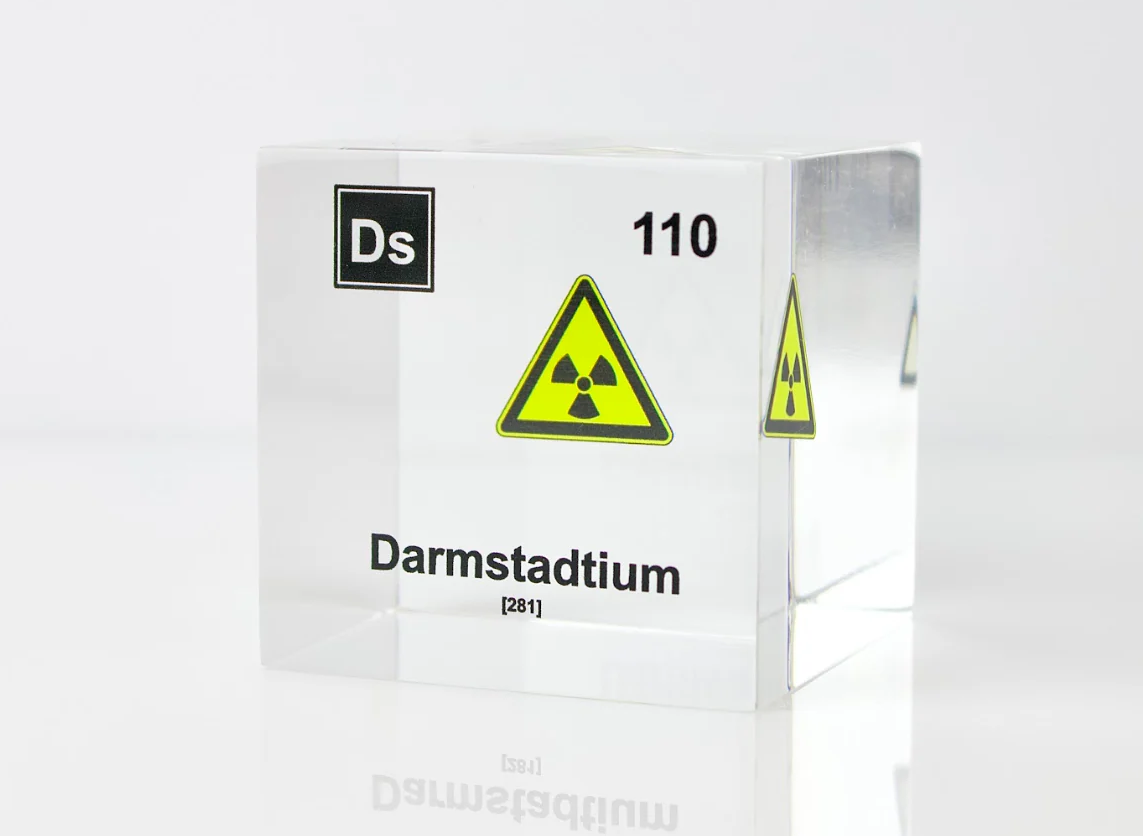
Darmstadtium (Ds, atomic number 110), one of the most extreme members of the superheavy elements, sits in group 10 of the periodic table — right below nickel, palladium, and platinum. Named after the German city of Darmstadt, home of the GSI Helmholtz Centre for Heavy Ion Research where it was first synthesized in 1994, darmstadtium is the epitome of fleeting, barely-existent matter. It is created one atom at a time in heavy-ion fusion reactions, and even its most long-lived isotope lives for less than half a minute.
Yet despite being so incredibly short-lived, darmstadtium already shows us astonishing glimpses of relativistic chemistry pushed to the absolute limit and serves as a crucial stepping stone toward understanding what happens when nuclear and electronic structure start to seriously fight each other.
1. Hidden Features: Relativistic Madness & Group 10 at the Edge
- Extreme Relativistic Stabilization Very strong relativistic contraction of s and p1/2 orbitals + huge spin–orbit splitting of the 7p shell dramatically changes the expected chemistry. Many calculations predict that darmstadtium might behave chemically more like its lighter homolog platinum than like the elements immediately above it in the group — a very strong break in periodicity.
- Possible +6, +4, +2 Oxidation States Theory suggests that Ds⁶⁺ might be surprisingly stable (due to 6d⁴ configuration after losing 6 electrons), more stable than Pt⁶⁺. At the same time very high +2 state stabilization is also expected because of the extremely inert 7s² pair.
- Volatility & Adsorption Behavior Gas-phase chromatography experiments with darmstadtium (very difficult — only a few decay chains observed) show it adsorbs quite strongly on gold surfaces — more strongly than the very volatile flerovium and copernicium, suggesting at least some metallic / platinum-like character is preserved.
- Nuclear Structure & Fission-Dominated Decay All known darmstadtium isotopes (mainly ²⁶⁷–²⁷³Ds, ²⁷⁹Ds, ²⁸¹Ds) decay very quickly — mostly by α-decay, with half-lives ranging from microseconds to ~12.7 seconds (²⁷³Ds being the current record holder). Very little is known about spontaneous fission branching — but it is clearly rising very fast as we go heavier.
2. Covert Uses: Almost Pure Fundamental Benchmark
Darmstadtium has zero practical applications — and almost certainly never will have any.
Its entire scientific importance can be summarized in a few extremely high-value fundamental roles:
- Most stringent test of relativistic quantum chemistry Every observed chemical property (adsorption energy, volatility trend) is a very hard benchmark for the most advanced relativistic many-body calculations
- Mapping the shore of the island of stability Darmstadtium lies in a very important transition region: How quickly does spontaneous fission take over? How much longer can we survive before fission completely dominates?
- Last relatively well-studied group 10 superheavy Because several relatively long-lived isotopes exist and because it has been made in different reactions, it serves as an important reference point when we try to understand the even heavier group 10 element copernicium (112) and the still heavier ones.
- Proof of concept for very heavy element chemistry Successfully performing gas-phase chemistry on something that exists for only ~10 seconds and in single atoms is one of the most impressive technical achievements of modern nuclear science.
In summary, darmstadtium isn’t just another superheavy — it’s one of the heaviest elements on which we still managed to do meaningful single-atom chemistry, it’s a brutal test for the most extreme relativistic quantum chemistry calculations, and it’s sitting right on the razor edge where nuclear existence starts to become dominated by spontaneous fission.
Darmstadtium barely exists long enough to remind us how fragile and exotic the very edge of the periodic table really is.
Which superheavy group 10 element intrigues you more — nickel (the workhorse), darmstadtium (the fleeting chemistry record), or maybe copernicium (the extremely noble superheavy)?
Drop your thoughts below!