

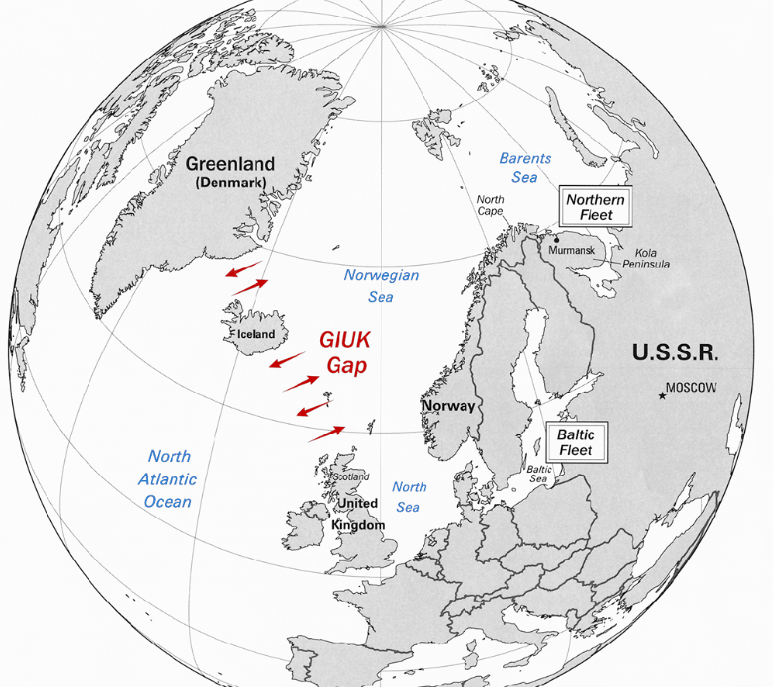
In the cold reaches of the North Atlantic, the Greenland–Iceland–United Kingdom Gap has never been merely a stretch of water. It is the narrow maritime throat through which Russia’s Northern Fleet must pass to reach the open Atlantic and challenge Western sea control. In January 2026, that long-standing reality has taken on renewed urgency. President Donald Trump has intensified pressure on Denmark over Greenland, explicitly linking the island’s strategic value to his ambitious Golden Dome missile defence initiative. At the same time, defence circles have begun to explore a parallel hypothetical: a future in which the United States acquires Greenland and the United Kingdom secures formal control or permanent basing authority in Iceland. Together, these moves would place the entire GIUK corridor under effective Anglo-American command, transforming it from a contested transit zone into a heavily monitored and potentially restrictive barrier for Russian naval forces.
Geographically, the Gap appears deceptively simple. It spans roughly twelve hundred miles of turbulent sea between Greenland’s eastern coast, Iceland’s southern approaches and the northern edge of the British Isles. Strategically, however, it remains indispensable to Russia. The Northern Fleet, headquartered at Murmansk and Severomorsk on the Kola Peninsula, fields Moscow’s most capable naval assets, including Yasen-M class attack submarines and Borei-class ballistic missile submarines that underpin Russia’s sea-based nuclear deterrent. In any high-end conflict, these vessels would need access to the Atlantic to threaten transatlantic supply lines, strike NATO targets from unexpected vectors or disrupt the flow of reinforcements from North America to Europe.
Moscow has long recognised this vulnerability. Russian naval doctrine prioritises the creation of protected bastions in the Barents and Kara Seas, where submarines can operate under the cover of layered air, surface and undersea defences. Yet despite climate change and the gradual opening of Arctic routes, the GIUK Gap remains the shortest, most reliable and least seasonal exit to the Atlantic. Alternative northern passages, even with Russia’s growing fleet of nuclear icebreakers, are longer, riskier and more exposed to weather and surveillance. The Gap, by contrast, remains the most efficient gateway.
If the United States were to gain sovereignty over Greenland, the strategic consequences would be profound. Pituffik Space Base, already central to missile warning and space surveillance, could be expanded without Danish political constraints. Additional radar arrays, enhanced satellite tracking facilities and extended airfields would turn Greenland into a forward operating fortress astride the northern approaches to the Atlantic. Trump’s insistence that Greenland is vital for the Golden Dome magnifies this shift. The system, envisioned as a layered network of ground-, sea- and space-based interceptors, is designed to counter ballistic, hypersonic and advanced cruise missiles. Greenland offers ideal geography for northern sensors and interceptors, strengthening early warning and potentially enabling limited boost-phase interception of missiles launched from Russian territory or Arctic waters.
A parallel expansion of British control or basing rights in Iceland would complete the picture. Keflavik Air Base could be transformed into a permanent hub for maritime patrol aircraft, anti-submarine warfare assets and advanced undersea sensor networks. Building on existing NATO arrangements, such a posture would allow continuous monitoring of submarine traffic through the Gap. AI-assisted sonar systems, seabed arrays and unmanned underwater vehicles could dramatically narrow the margin for undetected transit, even for Russia’s quietest platforms.
The combined effect of these developments would be formidable. Russian submarines attempting to break into the Atlantic would face persistent detection risks, forcing them either to remain confined within Arctic bastions or to adopt longer and more hazardous routes. This would constrain Russia’s ability to project conventional naval power and complicate the survivability of its sea-based nuclear deterrent during a crisis. Western control of the GIUK Gap would also secure undersea communications cables, protect transatlantic reinforcement corridors and consolidate access to Greenland’s rare-earth resources, materials increasingly critical to advanced weapons systems and energy transitions. Overlaid with the Golden Dome, such control would extend beyond maritime dominance to homeland defence, challenging long-standing assumptions of mutual vulnerability that underpin nuclear deterrence.
Yet this scenario is not decisive in isolation. Russia has spent years developing capabilities designed to reduce its reliance on vulnerable chokepoints. Hypersonic Zircon missiles, long-range Kalibr cruise missiles and the nuclear-powered Poseidon system can be launched from within protected bastions, striking targets across the Atlantic without a single submarine crossing the Gap. The Northern Sea Route, increasingly supported by year-round icebreaker escorts and new Arctic infrastructure, offers an alternative pathway, even if it remains slower and more resource intensive. Russia’s layered anti-access and area-denial systems, including S-400 and S-500 air defences and Bastion coastal missile batteries, further complicate Western efforts to impose uncontested control.
Beyond conventional military responses, Moscow retains a wide array of asymmetric tools. Hybrid operations targeting undersea cables, cyber networks and satellite systems offer means of imposing costs while staying below the threshold of open conflict. Information campaigns aimed at Greenlandic and Icelandic public opinion, along with diplomatic pressure in international forums, would seek to frame any territorial acquisitions as neo-colonial overreach. At the strategic level, Russia has already condemned the Golden Dome as destabilising, arguing that expansive missile defence erodes nuclear parity and incentivises arms racing, including the weaponisation of space.
The political risks of such moves are substantial. Denmark has warned that aggressive pressure over Greenland could fracture alliance cohesion. Iceland, despite lacking a standing army, remains deeply committed to its sovereignty and would likely resist any formal transfer of control. Rather than isolating Moscow, unilateral or coercive actions could alienate key European partners, strain NATO unity and accelerate closer Russian and Chinese cooperation in the Arctic. In response, Russia would almost certainly engage in visible nuclear and conventional signalling, increased patrols near the Gap and high-profile missile tests designed to underscore escalation risks.
Ultimately, the GIUK Gap remains what it has always been: a geographic constant shaped by shifting technology, politics and power balances. A consolidated U.S.–U.K. grip on Greenland and Iceland, combined with the ambitions of the Golden Dome, could impose a painful strategic constraint on Russia, forcing adaptations in naval posture and deterrence planning. It would not, however, constitute a decisive choke. Modern strike systems, alternative routes and asymmetric responses ensure that any such control would be contested rather than absolute. More perilous than the military consequences are the political ones. In the High North, where geography amplifies both leverage and vulnerability, the difference between strategic advantage and destabilising overreach remains perilously thin.