

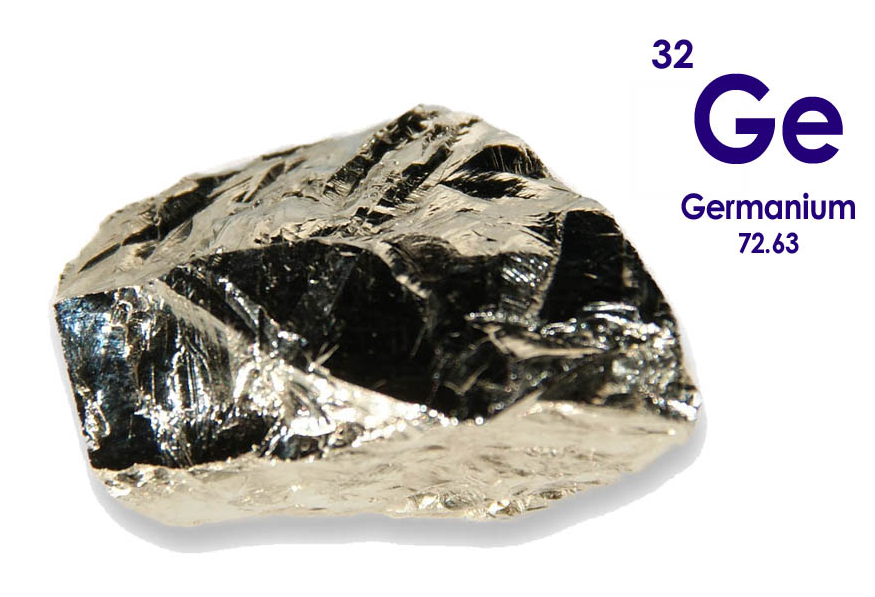
Germanium (Ge, atomic number 32), a lustrous, hard-brittle, grayish-white metalloid in group 14 (the carbon group, below silicon and above tin), was once the hero of the electronics revolution—now it’s experiencing a remarkable renaissance in the age of AI, 5G, quantum tech, and space power. Predicted by Mendeleev as “ekasilicon” in 1871 and discovered in 1886 by Clemens Winkler (named after Germany, his homeland), germanium powered the first transistors in 1947 at Bell Labs before silicon took over due to easier processing and higher abundance. Yet this underdog element hides extraordinary properties that keep pulling it back into the spotlight: superior electron/hole mobility, infrared transparency, and compatibility with silicon that silicon itself can’t match.
1. Hidden Features: Superior Mobility, Infrared Wizardry, and Relativistic Nuances
Germanium’s [Ar] 3d¹⁰ 4s² 4p² configuration gives it semiconductor behavior with a narrow indirect bandgap (~0.67 eV at 300 K), but its “hidden” strengths shine in ways silicon struggles to replicate.
- Record Electron & Hole Mobility: Germanium boasts the highest hole mobility of any common semiconductor (~1900 cm²/V·s vs. silicon’s ~450 cm²/V·s), and excellent electron mobility too. In strained Ge-on-Si layers, recent 2025 breakthroughs achieved hole mobilities up to 7.15 million cm²/V·s—an unprecedented leap—promising faster, cooler chips for next-gen electronics and quantum devices.
- Infrared Transparency & High Refractive Index: Germanium is nearly transparent from ~2–14 µm (mid- to far-infrared), with a high refractive index (~4.0) and low dispersion. This makes it ideal for IR lenses, windows, and prisms in thermal imaging, night-vision goggles, missile guidance, and space telescopes—where silicon absorbs IR too strongly.
- Direct Bandgap Potential in Nanostructures: Bulk Ge has an indirect bandgap, but strained or nanostructured forms (nanowires, thin films) can achieve quasi-direct behavior, enhancing light emission/absorption—key for silicon photonics, on-chip lasers, and high-efficiency photodetectors.
- Alloying Synergy with Silicon (SiGe): Silicon-germanium alloys enable band-gap engineering, boosting performance in heterojunction bipolar transistors (HBTs) for 5G/Wi-Fi, automotive radar, and high-speed data centers. SiGe’s tunable properties bridge silicon’s manufacturability with germanium’s speed.
- Optical & Quantum Quirks: Ge’s low bandgap allows strong IR absorption; in quantum dots or nanowires, it hosts unique quantum states for entanglement and superposition studies. High-purity Ge crystals power ultra-sensitive gamma-ray detectors (HPGe) in nuclear physics and environmental monitoring.
2. Covert Uses: Fiber Optics Backbone, Space Solar, Defense IR, and Emerging Chips
Global germanium demand (~150–200 tonnes refined metal/year) is small but critical, with China historically dominating supply—prompting 2025–2026 Western investments in refining and recycling.
- Fiber-Optic Communications: ~30–40% of Ge goes into GeCl₄ for doping silica fibers, increasing refractive index for signal transmission—enabling ultra-fast internet, AI data centers, and 5G/6G backhaul.
- Infrared Optics & Defense: Germanium lenses dominate thermal cameras, FLIR systems, night vision, and targeting pods—essential for military drones, tanks, and aircraft. Its durability in harsh environments is unmatched.
- High-Efficiency Solar Cells: Ge substrates enable multi-junction solar cells for satellites (efficiencies >35–40%), powering Mars rovers, deep-space probes, and constellations. Umicore and others are innovating to slash Ge use while maintaining performance.
- Semiconductors & Photonics Revival: Strained Ge-on-Si platforms drive next-gen transistors for lower-power, higher-speed logic—vital for AI accelerators and quantum computing interfaces. SiGe HBTs remain key in RF chips.
- PET Scanners & Radiation Detection: High-purity Ge detectors provide unmatched energy resolution for gamma spectroscopy in medical imaging (PET via Ge-68/Ga-68 generators) and nuclear safeguards.
In summary, germanium isn’t just silicon’s older sibling—it’s the high-mobility speed demon, the infrared gatekeeper, the photonics enabler, and the quiet powerhouse fueling satellites, defense tech, and the AI/quantum future.
What’s your favorite germanium story—the transistor that started it all, its IR magic in night vision, or its comeback in 2025–2026 chips? Drop it below!