

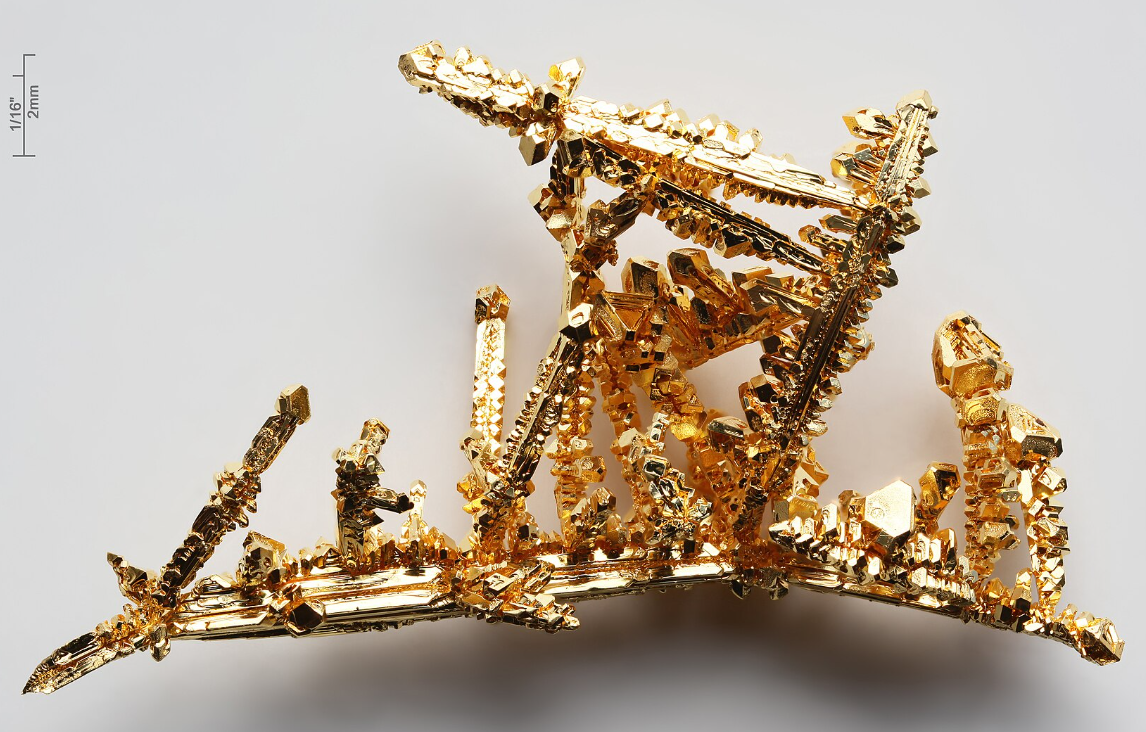
Gold (Au, atomic number 79), the classic yellow metal of kings, pirates, and central banks, is a dense, soft, malleable, and ductile transition metal in group 11 (below copper and silver). Known and prized since at least 4000 BCE, gold has been used as currency, jewelry, decoration, and status symbol across every civilization. Its chemical symbol Au comes from the Latin aurum (“shining dawn”). Despite being chemically inert and extraordinarily rare in the Earth’s crust (~0.004 ppm), gold’s unique combination of properties—extreme corrosion resistance, high reflectivity, and workability—has kept it at the pinnacle of human desire for millennia.
1. Hidden Features: Relativistic Yellow, Extreme Malleability, and Cosmic Origins
Gold’s electron configuration [Xe] 4f¹⁴ 5d¹⁰ 6s¹ reveals why it behaves so differently from lighter metals.
- Relativistic Color Origin Gold’s famous yellow hue is a direct consequence of relativistic effects. In heavy atoms like gold (Z=79), inner 5d and 6s electrons move at relativistic speeds (~0.58c), contracting the 6s orbital and widening the 5d–6s energy gap. This shifts absorption from ultraviolet (as in silver, which appears white) into the blue-green range—meaning gold reflects red/yellow light strongly, giving it that warm, lustrous color. Without relativity, gold would look silvery like most metals.
- Extreme Ductility & Malleability A single gram of gold can be hammered into a leaf covering ~1 m² or drawn into a wire ~2.4 km long. Gold leaf can be as thin as ~0.1 µm (about 400 atoms thick) yet remain continuous and reflective—used for centuries in gilding, illuminated manuscripts, and modern spacecraft thermal blankets.
- Highest Reflectivity in Infrared Gold reflects ~98–99% of infrared radiation—far better than silver or aluminum in the near- and mid-IR. This makes it ideal for space telescope mirrors (James Webb Space Telescope primary mirror coating), protective visors in astronaut helmets, and radiation shielding.
- Chemical Inertness & Noble Status Gold resists almost all acids (except aqua regia: 3:1 HCl:HNO₃) and does not tarnish or corrode in air or water—hence its use in electronics (gold plating on connectors) and dentistry (gold crowns, fillings). Its nobility stems from high ionization energy and relativistic stabilization of the 6s electron.
- Cosmic Forging Gold is a r-process element—formed primarily in neutron star mergers (kilonovae) and rare core-collapse supernovae. The 2017 GW170817 event provided direct evidence: gravitational waves + gamma-ray burst + kilonova light curve matched models of rapid neutron capture producing heavy elements like gold.
2. Covert Uses: Electronics, Space, Medicine, and Central Bank Reserves
Global gold production is ~3,000–3,500 tonnes/year, with ~50% going to jewelry, ~40% to investment (bars, coins, ETFs), and the rest to industry and central banks.
- Electronics & Connectivity Gold’s unmatched corrosion resistance and conductivity make it essential for high-reliability contacts: smartphone connectors, CPU pins, edge connectors on circuit boards, and military/aerospace wiring. Even tiny amounts (nanograms to micrograms per device) ensure signal integrity over decades.
- Space & High-Tech Mirrors Gold coatings protect satellites from solar radiation, line telescope mirrors (e.g., JWST, Hubble secondary), and shield astronaut visors from UV/IR. Gold-plated Mylar blankets insulate spacecraft and Mars rovers.
- Medicine & Dentistry Gold nanoparticles are explored for targeted drug delivery, cancer photothermal therapy, and diagnostics (gold colloid in pregnancy tests). Gold salts (aurothiomalate) were historically used for rheumatoid arthritis; dental gold alloys remain durable for crowns and bridges.
- Central Bank & Investment Role As of 2026, central banks hold ~35,000–36,000 tonnes of gold reserves (US ~8,133 t, Germany ~3,352 t, IMF ~2,814 t). Gold remains a hedge against inflation, currency devaluation, and geopolitical risk—prices often spike during uncertainty.
- Nanotechnology & Catalysis Gold nanoparticles (especially 2–10 nm) are highly active catalysts for CO oxidation, selective hydrogenation, and water splitting—surprising for a “noble” metal. Gold clusters enable new green chemistry routes.
In summary, gold isn’t just a precious metal—it’s the relativistic yellow wonder forged in neutron-star collisions, the corrosion-proof conductor in your phone, the mirror that sees distant galaxies, and the timeless store of value that has outlasted empires.
What’s your favorite gold story—the way relativity makes it yellow, its role in space tech, or the sheer romance of ancient treasure? Drop it below!