

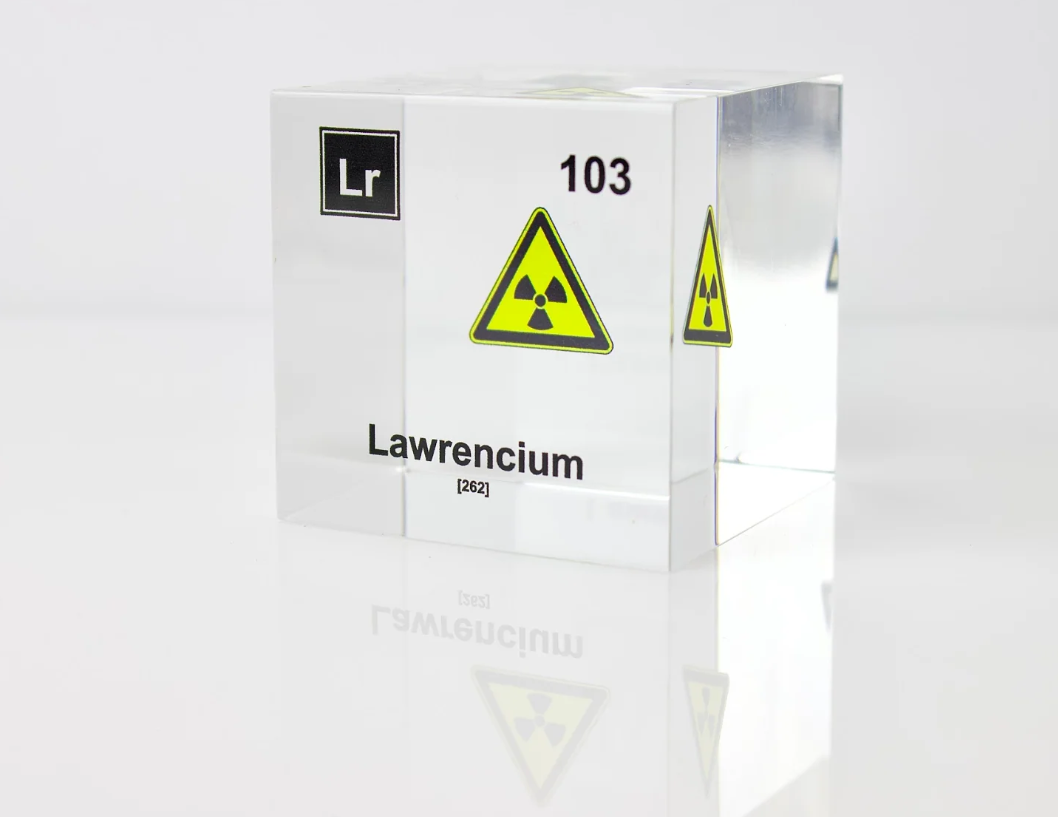
Lawrencium (Lr, atomic number 103), the last element of the actinide series and the final f-block element in the periodic table, stands as the heaviest chemically characterizable actinide and one of the most elusive corners of known matter. Named after Ernest O. Lawrence—the inventor of the cyclotron and founder of Lawrence Berkeley National Laboratory (LBNL)—lawrencium was first synthesized in 1961 by Albert Ghiorso, Torbjørn Sikkeland, Almon E. Larsh, and Robert M. Latimer at Berkeley via the bombardment of californium-249 with boron-10 or -11 ions. It exists only through accelerator production, atom by atom, with no stable isotopes and the longest-lived one decaying in mere hours.
Despite production rates measured in single atoms per day (or less), lawrencium has become one of the most important benchmarks in superheavy-element chemistry—proving that meaningful single-atom studies are possible even at the very edge of the actinide row.
1. Hidden Features: 7p Pioneer, Relativistic +3 Stability, and Actinide Endpoint
Lawrencium sits at Z=103, where relativistic effects reshape orbitals while the actinide contraction reaches its extreme.
- First 7p Element – Configuration Breakthrough Long-debated predictions finally converged (supported by relativistic DFT and experimental volatility data) on the configuration [Rn] 5f¹⁴ 7s² 7p¹. Lawrencium is the first element to place an electron in the 7p orbital, making it the true chemical bridge from the actinides (5f-filling) to the yet-unsynthesized 7p series (elements 104–112 in their ground-state configurations).
- Surprisingly Classical +3 Behavior Gas-phase chromatography experiments (primarily 2015–2018 at GSI/FAIR, with follow-ups at JAEA and later refinements) showed lawrencium adsorbs on quartz and metal surfaces with enthalpies and volatilities extremely close to those of lutetium (its lighter 4f homolog) and heavier lanthanides. This confirms a highly ionic Lr³⁺ state—the 7p electron is relatively easy to remove despite relativistic stabilization of s and p₁/₂ orbitals. Early fears of dominant +1 or inert-pair effects did not materialize.
- Actinide Contraction Climax Lawrencium has the smallest ionic radius of all actinides (~0.86–0.88 Å for Lr³⁺), completing the actinide contraction driven by poor 5f shielding + relativistic effects. This shrinkage produces systematic, predictable changes in volatility and adsorption down the series—making Lr the ultimate test of whether actinide trends survive to the very end.
- Nuclear Properties 14 known isotopes (²⁵⁴Lr to ²⁶⁷Lr); longest-lived is ²⁶²Lr (half-life ≈ 4 hours, α-decay dominant with some EC and SF branches). Production typically uses ²⁴⁹Cf(¹⁵N,4n)²⁶⁰Lr or heavier targets. No evidence of enhanced stability near N=184—lawrencium lies well before the predicted island.
- Relativistic Benchmark As the heaviest actinide with successful gas-phase chemistry, every adsorption datum rigorously tests multi-electron relativistic Hamiltonians (Dirac–Coulomb–Breit + QED) for f-block elements—codes that must correctly handle 5f/6d/7s/7p mixing and spin–orbit effects.
2. Covert Uses: Pure Fundamental Anchor, No Bulk Existence
Lawrencium has zero practical applications—its production is orders of magnitude too low even for meaningful tracer work.
Its scientific importance, however, is outsized:
- Final Actinide Reference Lawrencium anchors the entire actinide series, allowing precise extrapolation of ionic radii, redox potentials, hydrolysis, complexation, and volatilities—data vital for modeling spent nuclear fuel, actinide partitioning, transmutation, and repository safety.
- Relativistic Chemistry Validation Single-atom adsorption studies on Lr provide the last chemically accessible f-block point before relativistic effects become overwhelmingly dominant in the transactinides (Rf–Og). Any deviation from theory refines models used for elements 104–120.
- Nuclear Structure Insight Decay properties and production cross-sections help map single-particle levels at the end of the 5f shell and the onset of 7p occupancy—guiding theoretical predictions for superheavy stability islands.
- Technique Showcase Detecting and chemically characterizing an element produced at picobarn cross-sections with half-lives of hours demonstrates the astonishing maturity of recoil separators, gas-phase chromatography at one-atom levels, and fast chemistry setups.
In summary, lawrencium isn’t just the last actinide—it’s the relativistic endpoint of the f-block, a surprisingly well-behaved +3 ion despite its extreme nuclear charge, and the final element on which we can still perform meaningful chemistry before the periodic table plunges into purely nuclear-dominated superheavy territory.
Which boundary element intrigues you more—lawrencium as the actinide curtain call, or oganesson as the current table’s endpoint? Drop it below!