

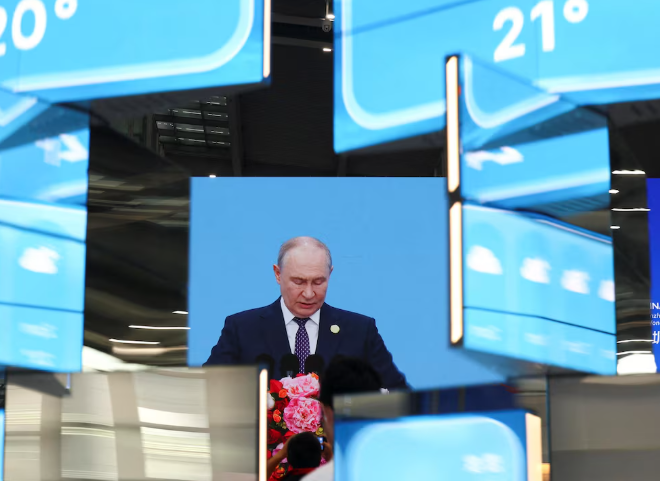
Russian President Vladimir Putin’s announcement at the Asia-Pacific Economic Cooperation summit signals an important effort to strengthen Russia’s economic position in the Arctic and Far East. By introducing a unified investment incentive regime from January 2027 and simplifying the testing of advanced technologies, Moscow is seeking to attract Asian capital into regions that have become increasingly important to its economic and strategic priorities. The initiative comes at a time when Western sanctions have restricted Russia’s access to important sources of investment and technology, while growing geopolitical competition has increased the significance of Arctic resources and maritime routes. Putin’s message to Asia-Pacific investors is clear. Russia wants the Arctic and Far East to become major centres of international commercial activity rather than remain dependent primarily on resource extraction.
Addressing business executives at the APEC CEO summit in Shenzhen, Putin presented the new arrangements as an opportunity for investors seeking access to the Russian market. Eligible businesses will receive tax concessions on profits, property and land, reduced payroll contributions and preferential leasing conditions. The regime will apply across the Russian Far East and Arctic from January 1, 2027. Moscow also intends to establish special legal conditions for testing drones, industrial robots and artificial intelligence in both regions. The proposal combines conventional investment incentives with opportunities for technological development, reflecting Russia’s intention to attract businesses involved in manufacturing, automation and emerging industries.
The timing is significant. Since the escalation of the Ukraine conflict in 2022, Russia has faced extensive Western restrictions affecting finance, technology and international trade. These pressures have increased Moscow’s reliance on economic partnerships with Asian countries and encouraged it to redirect commercial activity towards the east. The APEC platform provides an opportunity to present Russia’s investment potential directly to businesses from economies that remain important to its trade ambitions. Putin’s appeal also carries a wider message. Moscow wants to demonstrate that international restrictions have not eliminated its capacity to pursue major infrastructure and development projects.
However, tax concessions alone will not guarantee substantial foreign investment. Businesses considering projects in the Arctic must account for difficult climatic conditions, long distances, high infrastructure costs and uncertainty surrounding international trade. They also need confidence that investments will remain commercially viable over the long term. The proposed regime may improve the attractiveness of the region, but its effectiveness will ultimately depend on whether Russia can provide reliable infrastructure, predictable regulations and access to the technology required to operate in these demanding environments.
The Far East and Arctic occupy complementary positions in Russia’s economic strategy. The Far East provides access to Pacific markets, while the Arctic offers energy resources, mineral wealth and a maritime corridor connecting Europe and Asia. Putin highlighted the modernisation of the Trans-Siberian and Baikal-Amur railways, the expansion of Pacific port capacity and the development of infrastructure along the Northern Sea Route. These projects are intended to strengthen transport connections between Russia’s interior, its resource-producing regions and international markets. The new investment regime is designed to support this wider development effort.
The Northern Sea Route is particularly important because it offers a potential alternative to conventional maritime connections between Europe and Asia. Running along Russia’s Arctic coastline, it can shorten certain shipping journeys compared with routes through the Suez Canal. Recent disruptions to West Asian shipping, particularly those associated with the US-Israeli war on Iran and instability around the Strait of Hormuz, have highlighted the vulnerability of established maritime chokepoints. These developments have renewed interest in alternative routes capable of supporting international trade.
Nevertheless, the Northern Sea Route faces considerable practical limitations. Arctic navigation is affected by seasonal ice conditions, extreme weather, limited port infrastructure and the need for specialised vessels. Icebreaker assistance, insurance costs and the availability of reliable navigation services also influence commercial decisions. A shorter route does not necessarily mean a cheaper journey. For the corridor to become a dependable international shipping option, Russia must demonstrate that it can provide the infrastructure and operational support required for regular commercial traffic.
There are, however, indications of growing international interest. Chinese shipping company Sea Legend launched a scheduled service through the route in August, while South Korean company PanStar completed a trial voyage to Europe in September. These developments suggest that international carriers are beginning to examine its commercial potential rather than treating it solely as a Russian infrastructure project. Their long-term participation will depend on whether the route can offer consistent advantages in cost, time and reliability.
India’s planned involvement is another important development. New Delhi intends to send its first pilot cargo vessel along the Northern Sea Route in 2027 as part of its efforts to expand maritime connectivity with Russia. The two countries have also been discussing a framework for cooperation on the corridor. For India, the route could provide an additional option for trade with Russia and strengthen its economic engagement with the Russian Far East. However, a pilot voyage should be viewed as an initial step rather than evidence of an established commercial shipping network. Regular operations will require suitable vessels, cargo availability, port facilities and arrangements for safe navigation.
For Moscow, participation from China, South Korea and India would strengthen the international dimension of its Arctic ambitions. It would also reduce the extent to which development depends on Western commercial involvement. Russia is seeking to present the Northern Sea Route as an international corridor with benefits for multiple economies, even though much of its infrastructure and administration remains under Russian control. The challenge is to persuade shipping companies that the route offers sufficient commercial value to justify the additional costs and risks.
The technology component of Putin’s announcement is equally relevant. Drones, industrial robots and artificial intelligence can improve the efficiency of operations in remote regions where conventional infrastructure and human access are limited. Drones can assist with surveying and monitoring, while robotics can support industrial facilities and logistics. Artificial intelligence can improve the management of transport networks and resource operations. By simplifying the testing of these technologies, Russia hopes to make the Arctic and Far East more attractive to companies developing advanced industrial solutions.
This ambition also reflects the importance of technological independence in Russia’s economic planning. Restrictions on access to Western technology have exposed vulnerabilities in several industrial sectors. Developing domestic capabilities and attracting cooperation from Asian partners have therefore become important priorities. Yet the effectiveness of the proposed testing framework will depend on access to components, investment and specialised expertise. The new legal arrangements may encourage experimentation, but converting successful trials into commercially viable industries will require sustained support.
Russia’s economic ambitions in the Arctic are unfolding against a difficult diplomatic background. Moscow was a founding member of the Arctic Council in 1996, an organisation established to promote cooperation on environmental protection, sustainable development and regional issues. Following the escalation of the Ukraine conflict in 2022, the other seven member states suspended much of their cooperation with Russia. This significantly weakened an established mechanism for addressing shared Arctic concerns. Although the council’s activities have continued in a reduced form, the political divisions have made comprehensive regional cooperation more difficult.
Putin has nevertheless repeatedly expressed interest in maintaining cooperation with the United States in the Arctic. In October, he confirmed that Moscow and Washington were exploring possible joint projects involving energy and advanced technologies. Such proposals indicate that Russia does not want geopolitical tensions to eliminate every possibility of commercial engagement. However, discussions should not be confused with an established partnership. Sanctions, political mistrust and competing strategic interests remain substantial obstacles to cooperation.
At the same time, Western governments are placing greater emphasis on the security dimension of the Arctic. The European Union’s recently adopted Arctic strategy gives increased attention to surveillance, infrastructure, military mobility and defence capabilities. Britain has also moved towards expanding its naval presence in the Arctic and North Atlantic. Statements by British political figures about preparing for possible strikes against Russian military installations on the Kola Peninsula have further contributed to Moscow’s concerns.
Russia has repeatedly warned that NATO’s growing military activity risks turning the Arctic into another arena of confrontation. Foreign Minister Sergey Lavrov has accused the alliance of driving the region towards militarisation while reaffirming Moscow’s stated commitment to preserving it as an area of peace and cooperation. This contrast highlights the widening gap between the economic and security approaches of the major powers. Russia wants to expand commercial activity and strengthen its control over Arctic infrastructure, while Western governments increasingly view regional developments through the lens of strategic competition.
The growing importance of the Arctic makes this division particularly consequential. The region contains valuable natural resources and offers opportunities for new maritime connections, but it also faces environmental vulnerabilities that require international cooperation. Shipping expansion, industrial development and military activity all increase the need for effective safety arrangements and environmental monitoring. The breakdown of political cooperation therefore creates risks that extend beyond the immediate disagreements between Russia and Western countries.
Putin’s APEC announcement must also be understood within the wider diplomatic setting of the summit. His planned discussions with US President Donald Trump and Chinese President Xi Jinping on November 19 provide an opportunity to place Russia’s economic interests alongside broader questions concerning international relations. Putin has presented the meeting as an opportunity for constructive engagement among major powers. Although the outcome remains uncertain, his participation allows Moscow to reinforce the message that Russia intends to remain an important actor in discussions about global economic and strategic affairs.
Ultimately, the proposed investment regime represents an attempt to turn Russia’s geographical advantages into long-term economic influence. The Far East offers access to Asian markets, while the Arctic provides resources and a potentially valuable shipping corridor. Modernising railways, expanding ports and encouraging technological development are necessary steps towards realising that potential. However, the success of these ambitions will depend on whether international investors are willing to commit capital and whether Russia can overcome the logistical, financial and political obstacles facing Arctic development.
The Northern Sea Route is likely to remain the most visible test of this strategy. Growing interest from Asian shipping companies and India’s planned pilot voyage indicate that the corridor is attracting wider attention. Yet its future will be determined by commercial reliability rather than political announcements. Russia must establish that the route can support safe, predictable and economically sustainable shipping.
Putin is therefore seeking to advance two objectives through the same initiative. The first is to attract investment and develop the Arctic and Far East as engines of economic growth. The second is to strengthen Russia’s position in a region where geopolitical competition is becoming increasingly pronounced. Whether Moscow can reconcile these objectives with the need for international cooperation will shape the future of its Arctic ambitions. The announcement at APEC is an important signal of intent, but the real measure of success will be the investment, infrastructure and commercial activity that follow.