

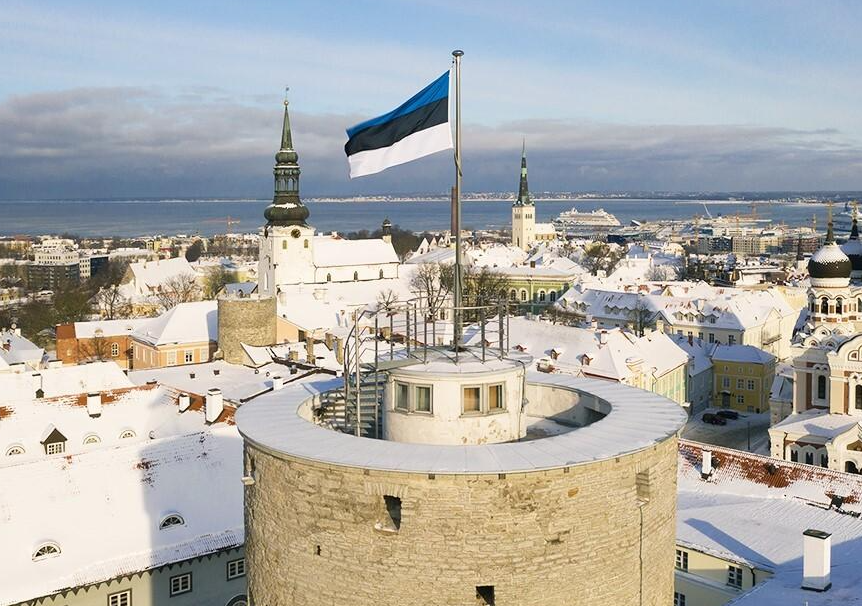
On February 24, 2026, Estonia celebrates Independence Day (Iseseisvuspäev), the country’s most important national holiday, marking the 108th anniversary of the declaration of the Republic of Estonia on February 24, 1918.
At 11:00 am on that historic day, the Estonian Salvation Committee (Päästmise Komitee) — led by Konstantin Päts, Jüri Vilms, and Konstantin Konik — proclaimed Estonia an independent democratic republic in Tallinn. The Manifesto to All the Peoples of Estonia was read aloud in the Alexander Nevsky Cathedral (now restored as an Orthodox cathedral) and published in newspapers, declaring Estonia “a democratic republic within its ethnographic borders” and calling for self-determination after centuries of foreign rule (German, Swedish, Russian, and others).
This act came amid the chaos of World War I and the collapse of the Russian Empire, just days before the Treaty of Brest-Litovsk (March 3, 1918) forced Soviet Russia to recognize Estonia’s independence (though it was later occupied by Germany, then regained in 1920 after the Estonian War of Independence).
February 24 has been celebrated as Estonia’s Independence Day since 1919 (when the War of Independence was ongoing) and remains the central symbol of Estonian statehood, sovereignty, and national identity — especially after regaining independence from the Soviet Union on August 20, 1991.
Significance in 2026:
- 2026 marks 108 years since the 1918 declaration — a powerful reminder of Estonia’s long struggle for self-determination and its remarkable recovery after 50 years of Soviet occupation.
- The day reaffirms core values: freedom, democracy, rule of law, Estonian language and culture, and integration into the Euro-Atlantic community (EU and NATO member since 2004).
- It is a moment of pride in Estonia’s digital innovation (e-Estonia), resilience, and small-nation success story, while also reflecting on the importance of defending sovereignty amid regional security challenges.
Celebrations and Observances:
- National ceremony in Tallinn: The main event takes place at the Parliament House (Riigikogu) on Toompea Hill. The President, Prime Minister, Speaker of Parliament, and military leaders raise the national flag (sinimustvalge — blue-black-white) at sunrise. A solemn ceremony includes the national anthem (“Mu isamaa, mu õnn ja rõõm”), speeches, and a 21-gun salute from the Seaplane Harbour or Tallinn Bay.
- Flag-raising across the country: At 7:00 am, the Estonian flag is raised on all public buildings, schools, homes, and flagpoles — one of the biggest flag-flying days of the year. Many Estonians wear national colors (blue-black-white ribbons) or traditional folk costumes.
- Cultural and patriotic events: Concerts, folk dance performances, and poetry readings (especially works by Gustav Suits, Juhan Liiv, and other national poets) take place in Tallinn, Tartu, Pärnu, Narva, and other cities. The Estonian Song and Dance Festival spirit is echoed in smaller events.
- Military tribute: The Estonian Defence Forces and Kaitseliit (Defence League) hold ceremonies at war memorials, with wreath-laying for independence fighters and victims of occupations.
- Public holiday activities: As a public holiday, government offices, banks, and most schools close. Families enjoy outdoor activities (weather permitting), visit historical sites (e.g., Estonian National Museum in Tartu), or attend concerts and fireworks in the evening.
- Symbolic acts: The national anthem is sung at public gatherings; many Estonians light candles at home or visit the Monument to the War of Independence in Tallinn; social media fills with blue-black-white flags and messages of pride.
Independence Day is Estonia’s most solemn and unifying national holiday — a day of quiet pride, reflection on freedom, and gratitude for those who fought to make Estonia a sovereign state.
A line from the national anthem often sung on this day: “Mu isamaa, mu õnn ja rõõm…” (“My fatherland, my joy and happiness…”)
On February 24, Estonia raises its blue-black-white flag high — remembering 1918, 1991, and every moment of struggle — and celebrates a small nation that refused to disappear. 🇪🇪