

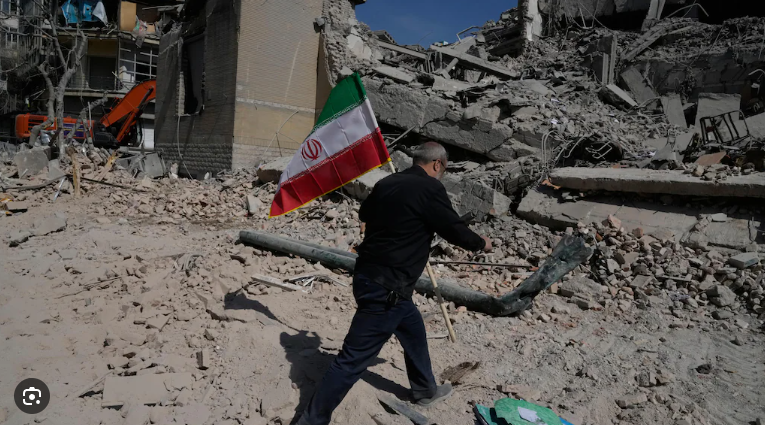
The current approach of the Trump administration toward Iran reflects a striking absence of clear, achievable objectives that could justify the scale of escalation. There is no credible pathway to secure the Strait of Hormuz, no realistic plan for regime change, no decisive move to neutralise nuclear capability, and no willingness to commit ground forces to secure strategic outcomes. Instead, the strategy relies heavily on air power, targeted assassinations, and pressure from a distance. This is not a doctrine of victory, it is a pattern of escalation without direction.
Operationally, the campaign has centred on sustained air power, echoing the playbook used by the Israel Defense Forces in Gaza, now adapted by United States Central Command with limited clear achievements. While such an approach can deliver tactical disruption, it has yet to produce a decisive shift in the broader strategic balance.
Against this, the Islamic Revolutionary Guard Corps presents a far more coherent posture. Despite sustained strikes, it remains operationally intact, strategically disciplined, and capable of calibrated response. Its command structure continues to function, its deterrence remains credible, and its ability to absorb and respond to pressure demonstrates a level of preparedness that the current offensive has failed to break. In asymmetric warfare, endurance is not weakness, it is strategy.
As military gains remain limited, the nature of targeting appears to be widening, raising serious concerns about civilian infrastructure and the humanitarian cost of the campaign. Such actions are increasingly scrutinised under International Humanitarian Law, not only for their legality but for their strategic value. When a campaign shifts away from decisive military objectives toward broader pressure tactics, it often signals an inability to achieve results where it matters most.
At the same time, public messaging continues to suggest openness to negotiation, even as escalation persists. This contradiction reflects a deeper imbalance between rhetoric and reality. While political narratives attempt to project control, the battlefield tells a different story, one where resistance has not collapsed and outcomes remain far from decisive.
The global implications are equally serious. Any sustained disruption in the Strait of Hormuz risks triggering a wider energy crisis, placing pressure on global markets and exposing the limits of external control over regional dynamics. If escalation continues without a clear objective, the conflict risks expanding into a broader confrontation, potentially drawing in multiple alliances.
And then there is Iran’s ultimate strategic leverage. According to the International Atomic Energy Agency, Iran has already produced uranium enriched to levels dangerously close to weapons grade, with stockpiles stored in hardened underground facilities and, at times, beyond full international visibility. This leaves Tehran with a critical option. If pushed into a corner, it retains the technical capability and knowledge to move rapidly toward a nuclear weapon. It is a wildcard that reshapes the strategic equation, not because it guarantees a bomb, but because it keeps that possibility alive under extreme pressure.
For Iran, and particularly for the Islamic Revolutionary Guard Corps, the equation is fundamentally different. Victory does not require overwhelming the adversary. It requires resisting long enough for the adversary’s strategy to exhaust itself. As long as internal cohesion holds and operational capability remains intact, time becomes an advantage.
In the end, this is not a war being won through decisive action. It is a test of endurance, perception, and strategic patience. And in that test, the side that continues to stand, absorb, and respond may ultimately shape the outcome without ever needing to claim a conventional victory.