

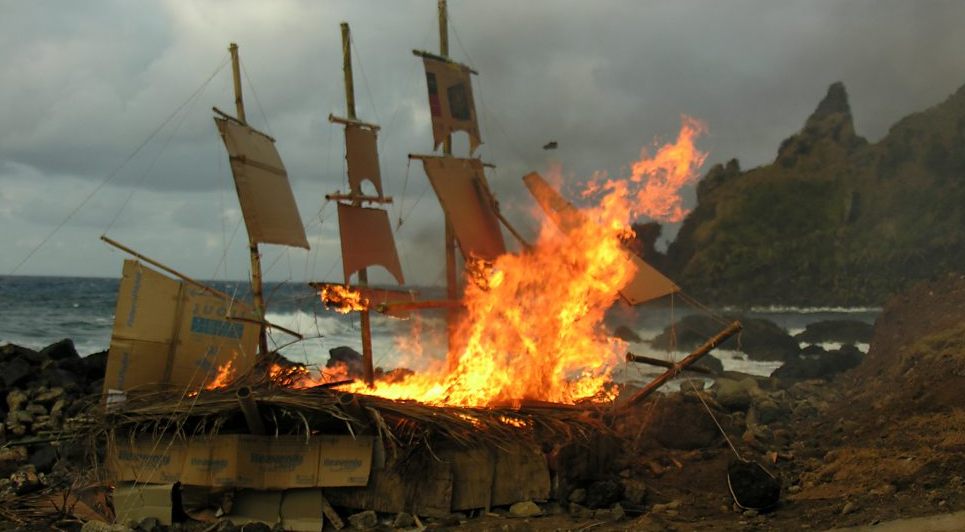
On January 23, 2026, the tiny British Overseas Territory of the Pitcairn Islands — the world’s smallest and most remote inhabited territory — celebrates Bounty Day, its most significant national holiday and the biggest event in the island’s calendar.
This day marks the anniversary of January 23, 1790, when the mutineers from HMS Bounty, led by Fletcher Christian, deliberately burned their ship in Bounty Bay to prevent discovery by British search parties and to eliminate any means of escape. The act sealed the fate of the nine mutineers, 12 Tahitian women, and six Tahitian men who had settled on the uninhabited island after the famous mutiny on April 28, 1789. The burning symbolized a complete break from the past, ensuring secrecy and commitment to their new life.
Today, nearly all of Pitcairn’s ~40–50 residents descend directly from those Bounty mutineers and Tahitians. Bounty Day honors this unique founding story, blending reflection on history with community celebration and pride in Pitcairn’s isolated, self-reliant heritage.
Celebrations and Observances:
- Fish fry and communal feast: The day centers on The Landing (near Bounty Bay), where locals organize a traditional fish fry using fresh catches from the surrounding Pacific waters. Families and the small community gather for shared meals, storytelling, and relaxation.
- Burning of the ship’s replica: A highlight is the ceremonial burning of a model or replica of the Bounty, reenacting the 1790 event. This dramatic fire-lit spectacle, often accompanied by fireworks, draws everyone to watch from the shore overlooking Bounty Bay.
- Community gatherings: With such a small population, the day feels intimate — music, laughter, and conversations about family lineages and island lore fill the air. Recent years (like 2025) have included special messages, such as congratulations from King Charles III read by the Mayor, acknowledging Pitcairn’s environmental efforts (e.g., the vast Pitcairn Islands Marine Reserve).
- Symbolic reflection: While festive, the day also nods to the mutiny’s complex legacy — adventure, rebellion, survival, and the blending of British and Polynesian cultures that defines Pitcairn identity.
Bounty Day is a public holiday on Pitcairn, with government offices, the small school, and limited services closed. It stands apart from Norfolk Island’s “Bounty Day” (or Anniversary Day) on June 8, which commemorates the 1856 arrival of Pitcairn descendants on Norfolk after overcrowding forced relocation.
In a place where history is lived daily — through surnames like Christian, Young, and McCoy, the Pitkern language (a creole mix of 18th-century English and Tahitian), and stories passed down generations — Bounty Day reinforces a profound sense of continuity and belonging.
On this remote Pacific outpost, Bounty Day celebrates not just a mutiny or a fire, but the enduring spirit of a people who forged a home at the edge of the world.