

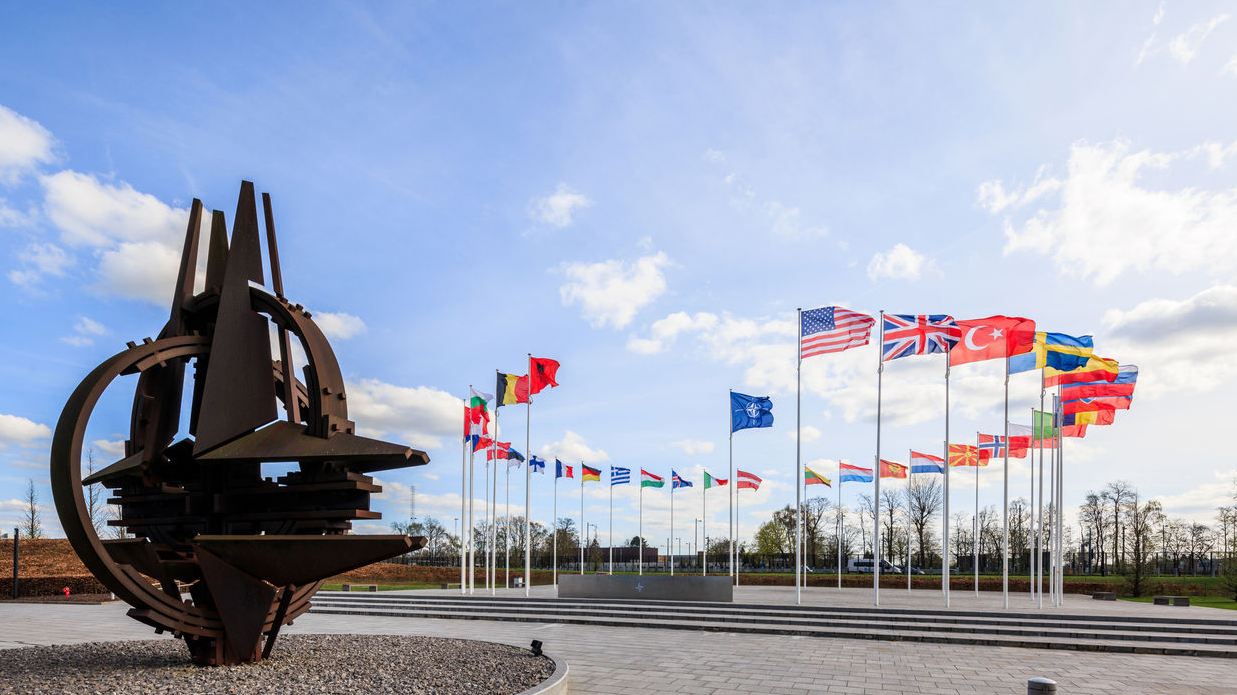
Today marks the 77th anniversary of the North Atlantic Treaty Organization. Leaders across member states and partner nations are marking the occasion with quiet ceremonies and familiar statements of unity. Founded on April 4, 1949 as a shield for collective defence, the alliance remains the central pillar of transatlantic security. Yet this year, the anniversary carries a sense of unease that is difficult to ignore.
For weeks, NATO has been facing one of its most serious tests in decades. The United States and Israel launched Operation Epic Fury against Iran on February 28, but NATO as an alliance chose not to join the fighting or commit naval forces to the Strait of Hormuz. This absence has triggered a wave of criticism. Donald Trump has openly attacked the alliance, calling it ineffective and warning of serious consequences. Senior voices in Washington have also hinted that the United States may reconsider its long standing relationship with NATO. In response, many analysts and experts have rushed to predict the beginning of the end for the alliance.
That conclusion, however, does not fully capture what is actually unfolding.
NATO’s decision to stay out of the Iran conflict is not hesitation or disunity. It is a calculated move rooted in its founding principle of collective defence. The alliance was never meant to participate in every conflict involving one or two of its members. By maintaining this boundary, NATO has preserved its legitimacy and avoided being drawn into a war that lacks consensus among its members. Rather than weakening the alliance, this restraint reinforces its credibility as a defensive pact.
On the ground, this strategic distance is clearly visible. Several European countries declined to provide airspace or operational support for offensive actions, signalling that this was not a NATO mission. While this has created friction with Washington, it has also allowed the alliance to maintain flexibility and avoid overextension. NATO has continued to keep its diplomatic channels open across West Asia without the complications that come with direct military involvement.
At the same time, the alliance has quietly expanded its outreach beyond the immediate conflict. Engagement with West Asian countries has remained steady. Relations with India have been maintained, while cooperation with Southeast Asian and Pacific partners such as Japan, South Korea, Australia and New Zealand has continued to grow in areas like maritime security and technology. This reflects a broader strategy of multilateralism, where NATO builds long term partnerships instead of reacting to every crisis with force.
The Iran conflict itself is already exposing the limits of unilateral action. Despite significant military strength, operations have faced resistance, and the situation has had ripple effects on regional stability and global energy markets. The idea that dominance in West Asia can be sustained by one or two powers alone is being tested in real time. Even smaller and regionally connected forces are capable of imposing meaningful costs.
For the United States, these developments are likely to carry long term implications. The current tensions appear closely tied to the political moment in Washington rather than a structural breakdown of the alliance. Statements from Donald Trump have intensified the perception of a rift, but they do not necessarily define the future of American strategy. The lessons from this conflict will extend beyond any single presidency.
Future American leaders, whether Democrat or Republican, are likely to approach NATO with greater caution and respect. Acting without strong allied backing has proven to complicate logistics, weaken legitimacy and increase both economic and military risks. The experience of the Iran conflict is likely to reinforce the idea that without NATO, the United States faces greater difficulty in sustaining its influence in West Asia. Even relatively smaller forces can challenge that dominance under the right conditions.
This does not mean NATO will overshadow the United States, but it does point toward a more balanced relationship. The alliance is not just a supporting structure. It is a force that enhances and stabilises power. Ignoring it carries consequences that are becoming increasingly visible.
Meanwhile, NATO’s own trajectory appears steady. By maintaining distance from the conflict while continuing to build relationships across regions, it is positioning itself for a broader global role. Its emphasis on multilateral engagement allows it to remain relevant in a changing world where rigid blocs are giving way to more complex networks of cooperation.
The coming months may still bring friction. Meetings between Donald Trump and NATO leadership, including Secretary General Mark Rutte, could produce further sharp exchanges. Yet history shows that alliances endure not through constant agreement but through their ability to adapt and absorb pressure.
At 77, NATO is not dissolving. It is recalibrating. The current crisis, rather than marking decline, may well become a turning point. By choosing restraint over reaction, the alliance is reinforcing its core identity while demonstrating the limits of unilateral power in a multipolar world.
The message from this anniversary is not one of weakness but of quiet confidence. NATO has survived deeper crises before, and it is likely to emerge from this one with renewed clarity about its role. The lesson from the Iran conflict is becoming increasingly clear, not just for one administration but for the United States as a whole. Alliances are not optional. They are essential.
In that sense, NATO at 77 stands not at the edge of dissolution, but at the beginning of a new phase where its strength lies not in immediate action, but in strategic patience and enduring partnerships.