

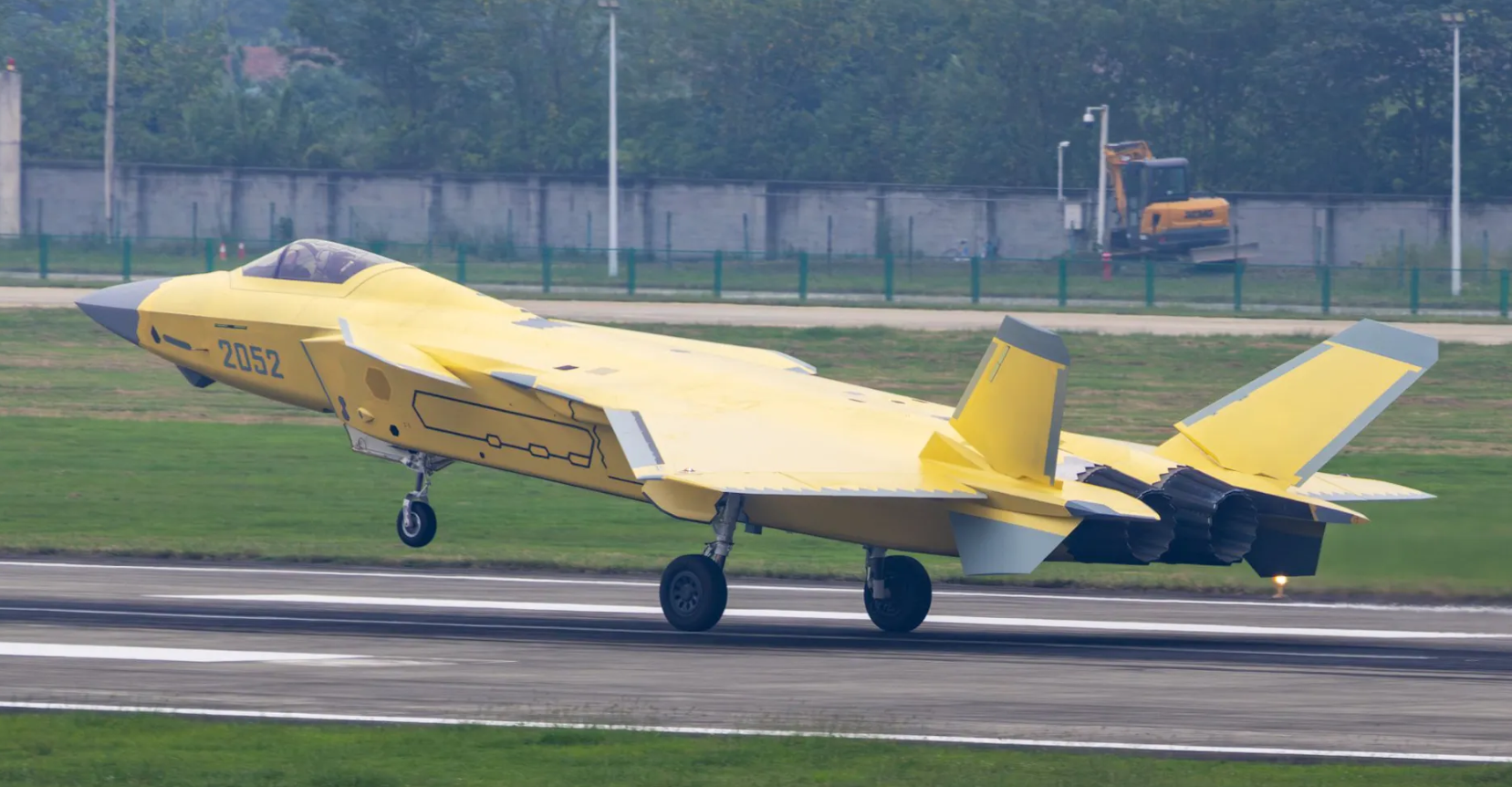
Beijing has released footage of flight tests of an upgraded J-20A stealth fighter, with signs that the jets have been equipped with long-awaited high-thrust WS-15 engines and better avionics.
– Chengdu Aircraft Corporation – the Aviation Industry Corporation of China subsidiary manufacturer of the J-20 stealth fighter – released new imagery and flight footage of its latest test aircraft on Saturday.
– These aircraft are new prototypes of the J-20A, an upgraded version of the original J-20 stealth fighter.
– The footage showed at least three J-20As in a yellow zinc-chromate primer taxiing on a runway.
– In the Chinese aerospace industry, the coating means the aircraft is in the pre-delivery testing phase, with the primer applied to protect the airframe before the final application of stealth coatings.
– The J-20 is a twin-engined heavy stealth fighter that entered service in 2017.
– China has been developing its improved version, the J-20A, including upgrades to its aerodynamic layout, avionics and engines.
– The J-20A made its first public appearance at the Victory Day parade in Beijing on September 3, but no details about the new model were revealed at that time.
– New footage confirmed that the J-20A had moved beyond the testing phase and was now being equipped with the WS-15 engine.
– The WS-15 can generate up to 18.5 tonnes of thrust – comparable to the F135 engine in the American F-35 fighter jet.
– This possible upgrade would enable the J-20A to achieve sustained supersonic flight without the use of fuel-heavy afterburners at speeds reportedly reaching Mach 1.8, with a theoretical maximum speed between Mach 2.5 and 2.8.
– Early J-20 prototypes and initial production batches used the Russian-made AL-31F engine but the engine did not generate enough power for true supersonic cruise, a hallmark of modern fifth-generation fighter jets.
– In 2019, the J-20 switched to the domestically produced WS-10C engine, but its thrust is thought to only allow for limited supersonic cruise.
– In September 2024, a sighting providing extremely clear images of a J-20A prototype, serial number 2052, parked on a runway.
– It believed the prototype was already equipped with China’s domestically produced WS-15 engine.
– Fu Qianshao, a retired People’s Liberation Army Air Force colonel, said that if the engine was a WS-15, its thrust would “increase significantly”.
– “Although fuel consumption will increase, it will be very beneficial for the J-20A to achieve supersonic cruise,” Fu added.
– The J-20A in the images featured a substantially raised dorsal spine behind the cockpit, dubbed the “fat-neck” J-20.
– Fu said the new design might have been meant to make room for improvements and adjustments to the avionics and electronic warfare systems. But he added that the wider fuselage would increase the aircraft’s air resistance.
– “If the airframe design modifications are done well, the changes in air resistance won’t be too significant,” Fu said. “And if the new engines are replaced, this drag won’t have a major impact.
– “Such modifications may also have allowed for the expansion of the dorsal fin behind the cockpit, enabling the aircraft to accommodate more avionics and fuel.”