

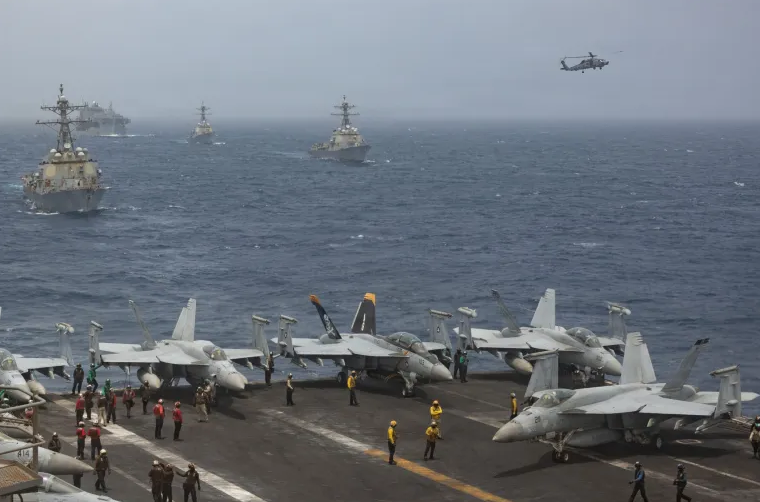
The Strait of Hormuz has long been understood as the geopolitical trachea of the global economy, a narrow, elbow shaped corridor through which twenty five percent of the world’s seaborne oil trade and twenty percent of its liquefied natural gas must pass. For decades, it existed as a relatively safe, internationally recognized transit route governed by universal custom. Today, it has mutated into an absolute theater of the absurd, transformed by the mutual hubris of Washington and Tehran into a toll booth battleground where global maritime law goes to die.
The descent into this current crisis began with terrifying speed on February 28, 2026, when coordinated U.S. and Israeli airstrikes under Operation Epic Fury struck deep within Iranian territory, aiming to cripple military and nuclear facilities. The immediate consequence, as the Joint Chiefs of Staff had privately warned, was the absolute weaponization of geography. Reeling from the strikes, the Islamic Revolutionary Guard Corps did what it had threatened for decades: it closed the throat of the global energy market. By deploying an asymmetric armada of speedboats, drones, anti ship missiles, and extensive fields of sea mines, Tehran choked daily transits from a pre war average of 130 ships down to a trickle. The global economy suffered its largest energy supply disruption since the 1970s, causing the largest single month spike in oil prices in historical memory.
Recognizing the unsustainable nature of an all out economic conflagration, regional mediators Pakistan and Qatar spent over a hundred days constructing a diplomatic bridge. The breakthrough arrived on June 17, 2026, when the United States and Iran signed the Islamabad Memorandum of Understanding. Framed at the Palace of Versailles, this highly anticipated 14 point framework was designed as a sequential de escalation mechanism. It demanded an immediate and permanent termination of military operations across all fronts, the immediate lifting of the U.S. naval blockade on Iranian ports, and the prompt reopening of the Strait of Hormuz to restore global oil flow. Crucially, the 14 point document established a 60 day window during which both nations were to remain frozen in an interim ceasefire while hammer and tongs negotiations commenced over permanent nuclear concessions, regional proxy networks, and comprehensive sanctions relief.
The ink on the Islamabad MoU was barely dry before both signees began weaponizing its deliberate ambiguities, treating a document meant for peace as a contract for tactical positioning. The core of the present collapse lies in the vastly conflicting interpretations of the maritime clauses within those fourteen points. U.S. officials maintain that the text explicitly mandated an unhindered, immediate restoration of standard international shipping rules, viewing any alteration of traffic as a bad faith violation. Tehran, conversely, seized upon a specific interim clause stating that Iran would make arrangements using its best efforts for the safe passage of commercial vessels with no charge for sixty days from the Persian Gulf to the Sea of Oman.
To Iranian legalists, “making arrangements” yielded a sovereign mandate to dictate the physical and administrative terms of transit. Exploiting this phrasing, Tehran formalized its leverage by establishing the Persian Gulf Strait Authority. This bureaucratic entity quickly mandated that all global vessel operators submit formal transit requests, share manifest data, and secure permits directly through Tehran before entering the channel. To enforce this, Iran mined the central deep water channels of the strait, effectively forcing all commercial traffic to hug the northern lane running directly through Iranian territorial waters. Ships refusing to comply or attempting to navigate the southern lane along the coast of Oman where the U.S. military had begun aggressively guiding escorted vessels were met with targeted drone and speedboat strikes. The United Kingdom Maritime Trade Operations Center documented at least six such targeted assaults on non compliant vessels in the waters near Oman, proving that Iran was using the 60 day window not to facilitate open trade, but to establish a permanent regulatory precedent over an international choke point.
The Iranian stance is a masterclass in bureaucratic revisionism. By creating the Persian Gulf Strait Authority, Tehran attempted to legitimize its historical extortion tactics under the guise of maritime safety and anti fraud administration. The 14 point MoU explicitly bound Iran to conduct dialogue with the Sultanate of Oman to define the future joint administration of the strait. By unilaterally enforcing a permit regime and attacking vessels utilizing the Omani route, Iran fundamentally violated the cooperative spirit and explicit text of the de escalation framework. Tehran used the text’s temporary ban on transit fees to entrench an administrative blockade, banking on the assumption that the international community would accept a loss of legal freedom in exchange for physical safety from Iranian mines.
President Donald Trump responded to this creeping administrative capture not with legal recourse or international coalitions, but by completely upending decades of American foreign policy doctrine. In a series of declarations on Truth Social, Trump announced that the United States would unilaterally reinstate its comprehensive naval blockade on all Iranian ports and vessels. Escalating his rhetoric further, he claimed that the U.S. military was effectively taking over the waterway, declaring that the nation would henceforth be known as the Guardian of the Hormuz Strait.
The true shockwave, however, lay in Trump’s embrace of the transactional playbook. Arguing that the United States had guarded the strait for over fifty years for nothing while other wealthy nations reaped the economic rewards, Trump announced a unilateral twenty percent toll on all commercial cargo transiting the strait. The rationale was framed as pure business: a reimbursement for the immense operational costs incurred by the U.S. Navy in providing security to a volatile region. By attempting to transform the U.S. Navy into a heavily armed maritime protection racket, Trump effectively legitimized the very premise of sovereign monetization that Washington had spent half a century opposing.
This transactional shift was immediately seized upon by Iranian Foreign Minister Abbas Araghchi, who took to social media to mock the American president. Araghchi noted with biting irony that the American President was absolutely right in concluding that whoever provides secure passage through the Strait of Hormuz should be financially compensated. Araghchi added that while twenty percent was an exorbitant demand, Iran would ensure its own impending toll system would be fair. With those few words, the Iranian regime successfully shifted the global narrative, using Trump’s own words to validate their long held ambition of turning the strait into a sovereign revenue stream.
The immediate casualty of this rhetorical and physical escalation is the United Nations Convention on the Law of the Sea, alongside centuries of established maritime tradition. Under international law, the Strait of Hormuz is defined as an international strait connecting an exclusive economic zone to the high seas, meaning the right of transit passage cannot be suspended, impeded, or taxed by coastal states. While legal scholars note that nations can levy minor fees for specific, tangible services rendered such as Chile’s pilotage fees in the Strait of Magellan these fees must be strictly commensurate with the actual service provided. They cannot be used as an economic tariff, a geopolitical weapon, or a mechanism for national profit. A twenty percent cargo toll imposed by Washington or a multi million dollar passage permit levied by Tehran are both flagrant violations of universal custom.
The consequences of this dual blockade strategy have been catastrophic for global commerce. Following the collapse of the interim ceasefire, maritime data indicates that vessel crossings through the strait plunged by an astonishing fifty two percent in a matter of days. The strategic waterway, which once accommodated over a hundred massive tankers every single day, has been quieted to a ghost town, with barely fourteen ships daring to risk the gauntlet. Shipowners now face an impossible mathematical matrix: comply with Iran’s Persian Gulf Strait Authority and face secondary American sanctions that sever access to the western financial system, or follow the U.S. route and face the physical reality of Iranian sea mines and loitering munitions.
The Islamabad Memorandum of Understanding was supposed to provide a 60 day cooling off period to prevent an absolute regional war. Instead, it has accelerated a terrifying race to the bottom. By treating the wording of the MoU as an invitation to construct a permanent regulatory blockade, Iran proved it values regional leverage over diplomatic normalization. By responding with a unilateral cargo toll and an assertion of total American ownership over international waters, the United States abandoned the moral high ground of defending global commons.
The Strait of Hormuz belongs neither to the Revolutionary Guard in Tehran nor to the executive branch in Washington. It belongs to the global architecture of free trade and international law. As both leaders continue to trade blockades, tolls, and military strikes, they are proving that the greatest threat to global stability is no longer just the eruption of kinetic warfare, but the total breakdown of the rules that prevent the world from sliding into economic chaos. If the principles of the Islamabad MoU cannot be restored, and if both nations persist in treating an international waterway as private property, the resulting conflict will not just be fought with warships, but will be paid for by every economy on Earth.