

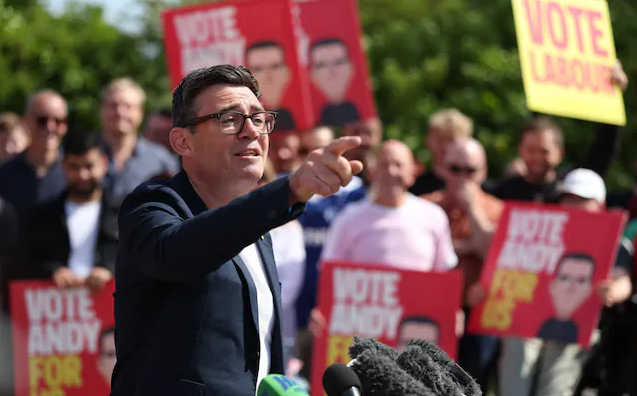
British politics may have witnessed a turning point with Andy Burnham’s emphatic victory in the Makerfield by-election. What appeared on the surface to be a routine parliamentary contest in one of Labour’s safest constituencies has rapidly evolved into something much larger: a direct challenge to Prime Minister Keir Starmer’s leadership and a referendum on the direction of the Labour Party itself.
Burnham’s victory was not merely a parliamentary gain. It was a political statement. Securing nearly 25,000 votes and defeating Reform UK by more than 9,000 votes, the Greater Manchester mayor transformed a local contest into a national platform. More importantly, he secured the one thing he lacked for a leadership challenge: a seat in the House of Commons.
For months, speculation had circulated about whether Burnham, widely regarded as Labour’s most popular politician outside Westminster, would seek a return to national politics. Makerfield has now provided that route. His warning in his victory speech that Labour faces a “final chance to change” was not directed at voters. It was directed squarely at Downing Street.
The significance of Burnham’s triumph extends beyond the numbers. It reflects a growing disconnect between Labour’s parliamentary leadership and large sections of its traditional electoral base. Two years after winning a landslide victory, Starmer finds himself facing a crisis few expected to emerge so quickly.
Historically, newly elected British prime ministers enjoy a substantial political honeymoon. Starmer’s government has experienced the opposite. A succession of policy reversals, internal resignations, public relations failures and economic frustrations has steadily eroded the political capital generated by Labour’s 2024 election victory.
Opinion surveys throughout 2026 have painted a bleak picture. Labour remains ahead of the Conservatives nationally, but largely because the opposition itself remains fragmented. The real beneficiary of public dissatisfaction has increasingly been Reform UK, which continues expanding its appeal across former Labour and Conservative strongholds alike.
The Makerfield result demonstrated this trend. While Burnham comfortably retained the seat for Labour, Reform UK finished second and significantly increased its vote share. That development will worry Labour strategists as much as Burnham’s leadership ambitions. It suggests that traditional party loyalties are weakening and that anti-establishment sentiment remains a powerful force in British politics.
What makes Burnham particularly dangerous for Starmer is that he occupies political territory few Labour figures can successfully claim. He combines establishment experience with outsider credibility.
Unlike many Westminster politicians, Burnham spent the last decade building a political identity outside Parliament. As Mayor of Greater Manchester, he cultivated an image as a defender of regional interests against what he repeatedly described as London-centric governance. During the Covid era he emerged as one of the most visible critics of central government policy, significantly enhancing his national profile.
His message resonates especially strongly across England’s former industrial regions, where frustration over economic stagnation, declining public services and regional inequality remains intense.
Burnham’s political appeal also reflects a broader debate about Labour’s future. Since becoming leader, Starmer prioritised electoral moderation, fiscal caution and political stability. His strategy succeeded in removing Labour’s image problem after the Jeremy Corbyn years and delivered a historic electoral victory.
However, winning power and governing effectively are different challenges.
Many Labour supporters increasingly argue that while Starmer succeeded in defeating the Conservatives, he has struggled to articulate a compelling vision for what Labour government should achieve beyond competence and stability.
Burnham is attempting to fill that vacuum.
His criticism of four decades of neoliberal economic policies speaks directly to voters who believe Britain’s economic model has failed to deliver prosperity beyond London and the South East. His calls for public investment, regional empowerment, transport infrastructure and industrial renewal echo concerns increasingly shared across the political spectrum.
Importantly, Burnham is not presenting himself as a radical insurgent. Unlike Corbyn, he does not seek to overturn Labour’s entire political framework. Instead, he positions himself as a practical reformer capable of reconnecting Labour with communities that feel abandoned by Westminster politics.
That distinction makes him potentially more formidable.
The challenge facing Starmer is compounded by Labour’s growing internal instability. Reports indicate that approximately a quarter of Labour MPs have publicly questioned his leadership since the party’s poor performance in local elections. Several high-profile ministerial resignations have reinforced perceptions of a government struggling with coherence and direction.
Although Labour’s rules require support from 20 percent of MPs to trigger a formal leadership contest, Burnham’s arrival in Parliament fundamentally changes the calculations of nervous backbenchers.
For many Labour MPs, the question is no longer whether Starmer faces a challenge. It is whether the party would be better served by managing an orderly transition rather than risking a prolonged decline in public support before the next general election.
Yet Burnham’s rise also presents risks.
Leadership contests are rarely bloodless affairs. Labour’s history is littered with internal conflicts that damaged the party’s electoral prospects. Starmer’s warning about the dangers of a divisive contest is not entirely self-serving. A prolonged struggle between competing factions could strengthen Reform UK, revive Conservative fortunes and undermine Labour’s governing credibility.
Moreover, Burnham’s popularity among voters does not automatically translate into parliamentary support. Many Labour MPs remain deeply loyal to Starmer or fear that changing leaders mid-term could appear reckless to the electorate.
The wider significance of Makerfield extends beyond Labour itself. It reflects a broader transformation underway in British politics.
The old political order that dominated Britain after the Brexit referendum continues to fragment. The Conservatives remain weakened after years of internal conflict and electoral defeats. Labour governs but struggles to inspire confidence. Reform UK continues expanding its influence. Regional leaders such as Burnham increasingly command political authority that rivals national figures.
In many ways, Burnham’s victory highlights a growing demand for political leaders who appear rooted in local realities rather than Westminster calculations.
The irony is that Labour won power promising change but now faces criticism for appearing too cautious to deliver it. Burnham’s challenge is built precisely upon that contradiction.
Whether he ultimately succeeds in replacing Starmer remains uncertain. Parliamentary arithmetic, internal party dynamics and public opinion will all shape the outcome. But one fact is already clear.
Makerfield was not simply a by-election.
It was the first major battle in what may become the defining political struggle inside Labour before the next general election. It exposed the fragility of Starmer’s authority, revealed the depth of dissatisfaction within the governing party, and elevated Andy Burnham from influential regional leader to credible national contender.
The question confronting Labour is no longer whether change is coming.
The question is whether Keir Starmer will lead it, or whether Andy Burnham will.