

The latest announcement by the United States, Australia and the United Kingdom at the Shangri La Dialogue in Singapore signals that AUKUS is entering a new phase. For years, public attention has remained focused on the ambitious plan to provide Australia with nuclear powered submarines under Pillar I of the agreement. Yet beneath the headlines surrounding submarines, another transformation has quietly been taking shape. The unveiling of a major trilateral project to develop advanced underwater drones reveals where the future of maritime competition is increasingly heading: autonomous systems, artificial intelligence, undersea surveillance and the battle for control of critical underwater infrastructure.
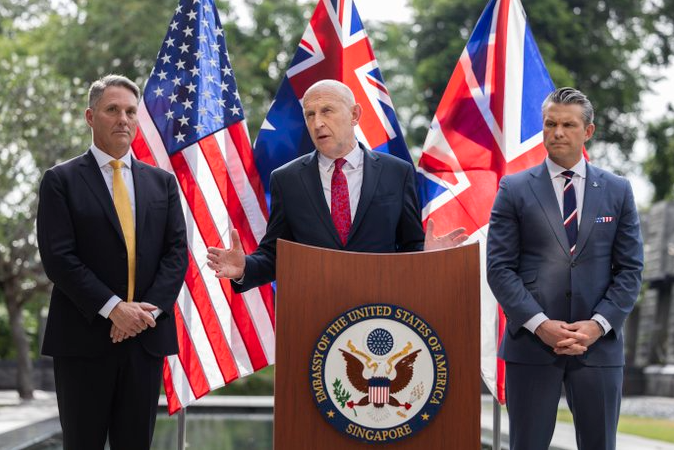
The announcement was made jointly by Pete Hegseth, Richard Marles and John Healey at the US Embassy in Singapore on the sidelines of Asia’s most important security gathering. The symbolism was deliberate. AUKUS was created in 2021 largely as a strategic response to the shifting balance of power in the Indo Pacific. Five years later, its architects appear eager to demonstrate that the partnership is producing tangible military capabilities rather than remaining a long term political vision.
The project falls under AUKUS Pillar II, the technology pillar of the agreement that focuses on advanced capabilities including artificial intelligence, quantum computing, cyber technologies, hypersonic systems and underwater warfare. While Pillar I remains centered on Australia’s acquisition of nuclear powered submarines, Pillar II has increasingly become the area where immediate operational results can be delivered. The new initiative aims to develop highly adaptable unmanned underwater vehicles capable of reconnaissance, anti submarine warfare, anti surface warfare, electronic warfare, mine countermeasures and precision strike missions. Deliveries are expected to begin in 2027.
The significance of the announcement extends far beyond military technology. Modern geopolitics is increasingly moving beneath the ocean surface. More than 95 percent of global internet traffic travels through undersea cables. Financial transactions, communications networks, military command systems and energy infrastructure all depend on vast underwater networks stretching across the world’s oceans. The growing concern within Western capitals is that these networks have become vulnerable targets in an era of hybrid warfare.
British Defence Secretary John Healey directly linked the project to the protection of undersea pipelines and communication cables, arguing that underwater drones would help detect, deter and respond to threats targeting critical infrastructure. His remarks reflected a broader concern that has emerged across NATO and Indo Pacific security circles following a series of incidents involving damaged cables in the Baltic Sea and around Taiwan.
Australian Defence Minister Richard Marles reinforced that concern by highlighting recent cases of severed subsea cables. He warned that if such incidents were intentional, they could represent efforts by certain states to test the political resolve of Western governments. The implication was clear. Future conflicts may not begin with missile strikes or naval battles. They may begin with unexplained disruptions to communication networks, energy systems and digital infrastructure located thousands of meters beneath the sea.
This explains why autonomous underwater vehicles are becoming strategically important. Traditional submarines remain among the most powerful military assets in the world, but they are expensive, limited in number and often reserved for high value missions. Underwater drones offer a different model. They can operate for extended periods, conduct surveillance across vast areas, inspect infrastructure, deploy sensors, hunt enemy submarines and potentially carry weapons, all while reducing risks to human crews. Their relatively lower cost also allows countries to deploy them in much larger numbers.
Pete Hegseth described the project as a way to preserve the three nations’ collective advantage in the maritime domain. His comments align with a broader strategic shift underway within the Pentagon. Increasingly, American military planners believe that future competition with China will be shaped not only by aircraft carriers and fighter jets but also by autonomous systems operating across land, sea, air, space and cyberspace.
The timing of the announcement is equally revealing. It came amid growing debate over whether AUKUS itself is progressing quickly enough. Critics in all three countries have argued that while political leaders frequently praise the partnership, practical outcomes have often moved slowly. John Healey openly acknowledged those concerns when he admitted that for too long AUKUS had “talked too much and delivered too little.” His remarks reflected growing pressure on all three governments to show measurable results.
That pressure is particularly intense in Australia. Questions continue to surround the long term viability of the nuclear submarine program, including concerns about costs, industrial capacity and delivery timelines. Debate has intensified following reports questioning whether the United States can produce enough Virginia Class submarines to meet both its own requirements and Australia’s future needs. Critics argue that Australia has committed itself to an extraordinarily expensive defence transformation without a clear fallback option if production schedules slip.
Against that backdrop, Pillar II offers something politically valuable. Unlike nuclear submarines, which may take decades to fully deliver, advanced underwater drones can be developed, tested and deployed within a much shorter timeframe. They provide visible evidence that AUKUS is generating military capabilities today rather than simply promising capabilities tomorrow.
The broader geopolitical context cannot be ignored. Although AUKUS officials rarely frame the initiative explicitly as an anti China alliance, the strategic logic is widely understood. The announcement occurred amid renewed warnings from American and Australian defence officials regarding China’s military expansion. At the Shangri La Dialogue, Hegseth described China’s military buildup as a major strategic challenge, while Marles again called for greater transparency regarding Beijing’s rapidly expanding capabilities.
China, meanwhile, continues to oppose AUKUS. Beijing has repeatedly argued that the pact risks triggering an arms race and undermining regional stability. Chinese officials have warned that deeper military integration among the United States, Australia and Britain could increase tensions across the Indo Pacific. The absence of China’s defence minister from this year’s Shangri La Dialogue only reinforced the sense that strategic competition between the two sides remains intense despite occasional diplomatic engagement.
Yet what makes the latest announcement particularly important is that it reflects a broader shift in how military power is being defined. Control of the seas is no longer determined solely by the size of a navy. Increasingly, it depends on the ability to dominate the underwater battlespace through sensors, autonomous systems, artificial intelligence and infrastructure protection. The ocean floor is becoming a strategic domain in its own right.
Recent discussions among defence officials in Singapore reflected this reality. Seventeen countries launched new frameworks for cooperation on protecting critical underwater infrastructure, acknowledging that cables, pipelines and communication networks have become essential components of national security. The emerging focus on underwater drones is therefore not simply about warfare. It is about safeguarding the invisible systems upon which modern economies depend.
The decision to accelerate development of unmanned underwater vehicles also reveals something deeper about the future of alliances. Traditional defence partnerships were built around troop deployments, military bases and shared operations. Modern alliances are increasingly being built around technological integration. Artificial intelligence, quantum systems, cyber capabilities and autonomous platforms are becoming as important as tanks, ships and aircraft.
For AUKUS, this may ultimately become the partnership’s defining legacy. The nuclear submarine program remains its most visible component, but the real strategic transformation may emerge from the creation of an integrated defence technology ecosystem linking American, British and Australian industries, research institutions and military forces.
The underwater drone initiative therefore represents more than a new weapons program. It is a glimpse into how future conflicts may be fought and how future alliances may function. As geopolitical competition intensifies across the Indo Pacific, the struggle for strategic advantage is increasingly moving beneath the waves. The latest AUKUS announcement suggests that Washington, London and Canberra intend to ensure they remain firmly ahead in that contest.