

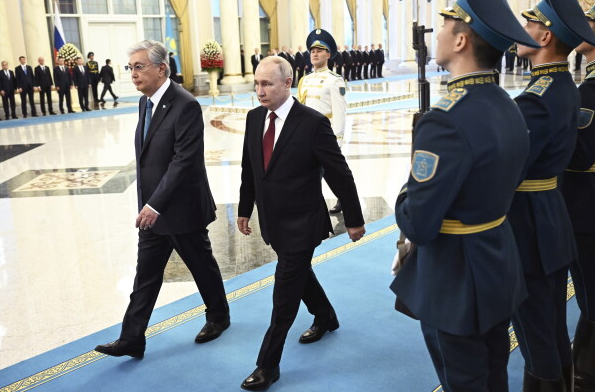
For years, discussions about Eurasia have been dominated by great power competition, sanctions, military conflicts, and competing transport corridors. Yet Russian President Vladimir Putin’s latest state visit to Kazakhstan suggests that the real story unfolding across the heart of the continent is not merely about competition. It is about the construction of long term strategic interdependence.
The visit carried significance well beyond the formal schedule of bilateral meetings. As Putin’s second state visit to Kazakhstan within two years, an unusually high frequency for top level diplomacy, it reflected the enduring importance of the relationship between Moscow and Astana. At a time when Central Asia has become an arena of growing interest for China, Türkiye, the European Union, the United States, the Gulf states and other external actors, the visit served as a reminder that Russia remains deeply embedded in the political, economic, security and infrastructural architecture of the region.
The symbolism surrounding the visit was equally important. Kazakh President Kassym-Jomart Tokayev personally welcomed Putin, military escorts accompanied the Russian leader’s aircraft, and multiple high profile meetings were arranged during the visit. Such gestures are not mere protocol. In diplomacy, symbolism often communicates strategic priorities more clearly than official communiqués. The message was unmistakable. Kazakhstan continues to pursue a multi vector foreign policy, but Russia remains one of its most important strategic partners.
The deeper significance of the visit lies in the institutionalisation of trust. Putin and Tokayev signed a new Joint Statement on the Seven Principles of Friendship and Good Neighbourliness, a document that seeks to codify the foundations of the relationship for the coming decades. The declaration covers shared history, economic partnership, border cooperation, Eurasian integration, cultural exchanges, educational cooperation, and a common vision of future development. In an era of geopolitical volatility, both countries are attempting to transform political trust into permanent institutions.
This is particularly significant because Eurasia is entering a period of profound restructuring. Global supply chains are being redrawn. Sanctions are creating alternative trade routes. Financial systems are becoming increasingly fragmented. Regional organisations are gaining greater importance. Against this backdrop, Russia and Kazakhstan appear determined to ensure that their partnership remains anchored in formal mechanisms rather than personal diplomacy alone. The seven principles document represents an effort to create strategic continuity regardless of future political changes.
Economically, the relationship is becoming increasingly difficult to separate. Russian investment in Kazakhstan has approached $30 billion, making Russia one of the largest investors in the Kazakh economy. According to official figures presented during the visit, the two countries are working on approximately 177 joint projects worth around $53 billion, with more than 120 already operational. These projects extend far beyond traditional energy cooperation and include manufacturing, engineering, chemicals, logistics, digitalisation and industrial production.
The scale of this economic integration is often underestimated. Thousands of companies with Russian participation operate inside Kazakhstan. Supply chains connect factories on both sides of the border. Industrial cooperation generates tens of thousands of jobs. Bilateral trade reached roughly $27.4 billion in 2025 and continues to expand despite sanctions pressures and broader global uncertainty. Even more importantly, both countries are increasingly using national currencies in mutual settlements, reducing dependence on external financial systems and strengthening economic resilience.
Geography continues to play a decisive role. Russia and Kazakhstan share the world’s longest continuous land border, stretching approximately 7,600 kilometres. Such geography creates realities that no political change can easily erase. Transport corridors, pipelines, migration flows, energy networks and border economies bind the two countries together in ways that make cooperation a strategic necessity rather than simply a diplomatic choice.
Energy remains at the core of this relationship. More than 80 percent of Kazakhstan’s oil exports continue to reach international markets through Russian territory via the Caspian Pipeline Consortium network. This reality gives Moscow significant importance within Kazakhstan’s export strategy while simultaneously making Kazakhstan an important component of Eurasian energy connectivity. Cooperation with Gazprom on gas infrastructure expansion further reinforces these linkages. Oil transit, gas transportation and cross border energy infrastructure have become strategic assets that tie the economic futures of both countries together.
Perhaps the most consequential outcome of the visit was the advancement of Kazakhstan’s first nuclear power project. After considering competing international proposals, including bids from Western and Asian suppliers, Kazakhstan chose Rosatom as the lead partner. This decision extends far beyond energy generation. Nuclear projects create decades long relationships involving financing, fuel supply, maintenance, technical expertise, personnel training and regulatory coordination. By choosing Rosatom, Kazakhstan effectively signalled that while it maintains relations with multiple global powers, it still views Russia as a trusted partner in strategically sensitive sectors.
The timing of the decision is also noteworthy. Kazakhstan has simultaneously strengthened relations with China, expanded cooperation with Türkiye, deepened engagement with European states and maintained dialogue with the United States. Yet when selecting a partner for one of its most important national infrastructure projects, Astana chose Moscow. That choice reveals much about the hierarchy of strategic trust in Eurasia.
The Eurasian dimension of the visit may prove even more important in the long run. Putin’s participation in the Eurasian Economic Forum and the summit of the Eurasian Economic Union underscored Kazakhstan’s central role within the Eurasian integration project. As sanctions reshape trade routes and protectionism increases across the global economy, regional economic institutions are becoming more valuable. For both Russia and Kazakhstan, the EAEU represents an institutional framework capable of facilitating trade, investment, logistics and industrial cooperation across a vast continental space.
This broader Eurasian context is critical because Kazakhstan today occupies a unique position. It is simultaneously engaged with China’s Belt and Road corridors, Türkiye’s growing influence across the Turkic world, European investment initiatives, and Eurasian integration structures centred around Russia. Rather than choosing one geopolitical camp, Astana has attempted to position itself as a bridge among multiple centres of power. Yet the latest visit suggests that this balancing strategy does not come at the expense of its partnership with Moscow.
Beyond trade and energy, cooperation is expanding into advanced technologies. The development of the Bayterek launch complex and the planned Soyuz 5 programme demonstrate continued collaboration in aerospace and space technology. The historic Baikonur Cosmodrome remains one of the most important symbols of technological cooperation between the two countries. Space programmes require long planning horizons, specialised expertise and substantial investment, making them among the strongest indicators of strategic trust between states.
What ultimately emerges from this visit is a picture of a relationship that extends far beyond conventional diplomacy. Russia’s influence in Central Asia is not sustained solely through military power or political pressure. It is reinforced through investment, infrastructure, trade corridors, energy networks, industrial projects, educational exchanges, technological cooperation and regional institutions. The relationship has become deeply embedded within the practical realities of Eurasian development.
For Kazakhstan, maintaining strong ties with Russia does not contradict its multi vector foreign policy. Instead, it reflects an understanding that geography, economics and infrastructure create enduring strategic realities. Astana may continue expanding relations with Beijing, Ankara, Brussels and Washington, but its partnership with Moscow remains central to its calculations regarding connectivity, energy security, industrial growth and regional stability.
As Eurasia undergoes one of the most significant geopolitical transformations since the end of the Cold War, Putin’s visit to Kazakhstan revealed something often overlooked in discussions about power. Influence in the twenty first century is increasingly measured not by military presence alone, but by the density of economic, technological, institutional and infrastructural connections. By that standard, the Russia Kazakhstan relationship remains one of the most consequential strategic partnerships on the continent.
The larger question is no longer whether Russia remains influential in Central Asia. The evidence suggests that it does. The more important question is whether the increasingly interconnected Moscow Astana axis will become one of the principal pillars upon which the future political and economic architecture of Eurasia is built. The latest visit suggests that both capitals believe it will.