

India’s renewed strategic engagement with Myanmar is increasingly becoming one of the most consequential developments unfolding across the Bay of Bengal and the wider Indo Pacific region. The meeting between Indian National Security Advisor Ajit Doval and Myanmar’s National Security Advisor Tin Aung San on the sidelines of the inaugural International Security Forum in Moscow was far more than a routine diplomatic interaction. It reflected the emergence of a broader geopolitical calculation inside New Delhi that Myanmar can no longer be viewed merely through the prism of border instability or internal conflict. Instead, India now sees Myanmar as a decisive strategic hinge connecting South Asia, Southeast Asia and the eastern maritime corridors of the Indo Pacific.
The Moscow meeting itself carried substantial symbolism. Russia has steadily positioned itself as a parallel diplomatic and defence platform for Asian powers seeking strategic flexibility outside Western dominated frameworks. Against that backdrop, the Doval-Tin Aung San engagement demonstrated that India and Myanmar are willing to continue expanding security coordination despite Western criticism of Naypyidaw’s military leadership. Officials from both sides reviewed cooperation in defence, connectivity, border security, infrastructure and regional stability. However, beneath the official diplomatic language lies a more urgent strategic reality. India is attempting to prevent the complete strategic absorption of Myanmar into China’s expanding geopolitical sphere while simultaneously securing its own vulnerable northeastern frontier.
Myanmar’s geographical location gives it extraordinary strategic importance in Asian geopolitics. It is the only ASEAN member state sharing both maritime and land borders with India. It borders the Indian states of Mizoram, Manipur, Nagaland and Arunachal Pradesh, all of which have historically faced insurgency challenges, cross border militant movement and trafficking networks. Any prolonged instability inside Myanmar directly spills into India’s Northeast through refugee inflows, narcotics trade, arms smuggling and ethnic insurgent sanctuaries operating along the porous frontier. This explains why New Delhi’s approach toward Myanmar has always remained fundamentally different from the West’s sanctions driven policy. India’s calculations are rooted not in ideological alignment but in strategic geography.
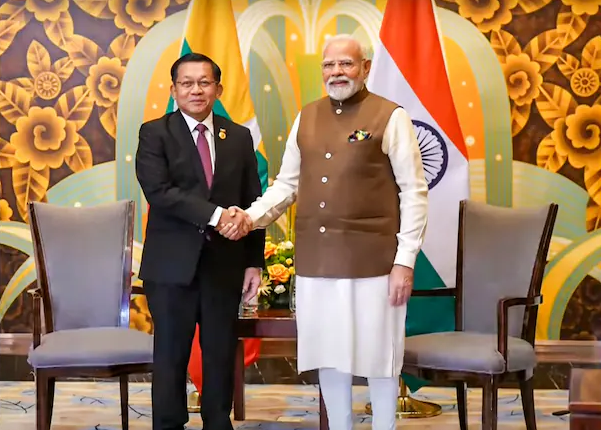
The timing of the Moscow talks is especially significant because they immediately precede Myanmar President U Min Aung Hlaing’s landmark official visit to India from 30 May to 3 June. Originally intended as participation in the International Big Cat Alliance Summit, the trip has now evolved into a full scale bilateral state visit at the invitation of Prime Minister Narendra Modi. The expansion of the visit reflects the growing importance both capitals attach to the relationship despite continuing instability inside Myanmar and rising geopolitical competition across the Indo Pacific. President Min Aung Hlaing will be accompanied by senior ministers, officials and business representatives, signalling that the visit is designed not merely for symbolic diplomacy but for long term strategic coordination across multiple sectors.
For New Delhi, Myanmar today sits at the intersection of three major strategic doctrines. The first is the Neighbourhood First policy, which prioritises stability and engagement with immediate neighbours. The second is the Act East policy, which seeks to deepen India’s economic and strategic integration with Southeast Asia. The third is the MAHASAGAR vision, India’s evolving maritime and regional connectivity framework across the Indian Ocean and Bay of Bengal. Myanmar is the bridge connecting all three. Without stable connectivity through Myanmar, India’s larger ambition of integrating its northeastern states with Southeast Asian markets and maritime trade corridors remains incomplete.
Connectivity projects are therefore expected to dominate discussions during the Modi-Min Aung Hlaing talks in New Delhi. Chief among them is the Kaladan Multi Modal Transit Transport Project, one of India’s most strategically important infrastructure initiatives in the region. The project aims to connect Kolkata Port with Myanmar’s Sittwe Port by sea, then link Sittwe through inland waterways and road corridors to India’s Mizoram state. Strategically, this corridor reduces India’s dependence on the narrow Siliguri Corridor, often described as the “Chicken’s Neck”, which currently acts as the primary land connection between mainland India and the Northeast. In any future geopolitical crisis or conflict scenario, the vulnerability of the Siliguri Corridor becomes a major strategic concern. The Kaladan project therefore is no longer viewed merely as an economic initiative. It has evolved into a strategic necessity tied directly to India’s national security architecture.
At the same time, India is accelerating work on the India-Myanmar-Thailand Trilateral Highway project, which aims to create direct road connectivity between the Indian subcontinent and mainland Southeast Asia. Although delayed repeatedly due to security concerns, difficult terrain and bureaucratic challenges, the corridor remains central to India’s long term regional integration plans. If fully operational, these connectivity routes could transform northeastern India into a major trade and logistics gateway rather than a geographically isolated frontier region.
Another major issue expected to dominate the talks is counter terrorism and border management cooperation. Several Indian insurgent groups historically operated from camps inside Myanmar’s border regions, particularly along the Sagaing and Chin areas. Over the years, India and Myanmar have conducted coordinated military operations against militant networks, including intelligence sharing and cross border security coordination. However, the internal fragmentation of Myanmar following the civil conflict has complicated the security landscape considerably. New Delhi is therefore seeking stronger institutional mechanisms to ensure militant groups do not exploit Myanmar’s instability to revive insurgent infrastructure targeting India’s Northeast.
The economic dimension of the visit is equally important. Myanmar remains rich in natural gas, minerals, rare earth elements and agricultural resources. India has steadily expanded investments in energy exploration, infrastructure, telecommunications and capacity building inside Myanmar. Recent discussions have also included possibilities for increased rupee-kyat trade mechanisms to bypass dollar dependency and facilitate smoother bilateral transactions. Indian businesses are increasingly exploring opportunities in logistics, port infrastructure, energy and pharmaceuticals as Myanmar seeks economic diversification amid Western sanctions and growing dependence on China and Russia.
The visit to Bodh Gaya by President Min Aung Hlaing before arriving in New Delhi is strategically symbolic as well. Bodh Gaya represents not only a sacred Buddhist pilgrimage centre but also India’s use of civilisational diplomacy as an instrument of regional influence. Buddhism remains one of the strongest historical and cultural links connecting India and Myanmar. By incorporating Bodh Gaya into the presidential itinerary, India is reinforcing soft power engagement alongside hard security cooperation. Such cultural diplomacy becomes especially important in maintaining people to people trust even during periods of political uncertainty.
The Mumbai leg of the visit also reflects a growing commercial dimension in bilateral relations. Meetings with Indian industry leaders and business groups indicate that both sides are exploring ways to expand industrial cooperation despite sanctions and political sensitivities surrounding Myanmar’s internal situation. India understands that economic disengagement would simply deepen Myanmar’s dependence on Beijing. As a result, New Delhi appears increasingly willing to pursue calibrated economic engagement while avoiding overt political endorsement of Myanmar’s domestic governance structure.
The broader geopolitical context makes this relationship even more significant. China has dramatically expanded influence inside Myanmar over the past decade through infrastructure investments, pipelines, ports, mining projects and diplomatic engagement with both the military leadership and ethnic armed organisations. Beijing’s China-Myanmar Economic Corridor under the Belt and Road Initiative provides China direct strategic access to the Bay of Bengal, reducing reliance on the Strait of Malacca for energy imports. This has enormous long term strategic implications for India and the wider Indo Pacific balance of power.
Russia too has emerged as a major player in Myanmar through defence cooperation, arms sales and energy engagement. Moscow has become one of Myanmar’s primary military suppliers while deepening nuclear and technical cooperation. The Moscow meeting between the two national security advisors therefore also reflected the growing strategic convergence emerging among regional powers operating outside Western geopolitical frameworks.
At the same time, India has carefully avoided becoming trapped in binary geopolitical alignments over Myanmar. Unlike several Western powers that prioritise sanctions and diplomatic isolation, New Delhi’s approach remains rooted in strategic pragmatism. India recognises that complete disengagement would create a vacuum rapidly filled by rival powers. The objective is therefore not endorsement of Myanmar’s internal political trajectory but preservation of regional stability, border security and strategic balance.
Myanmar’s National Security Advisor is also expected to visit India in July for the 5th BIMSTEC National Security Advisors’ meeting. This is another indication that India increasingly views Myanmar not merely as a bilateral partner but as a critical pillar of Bay of Bengal security architecture. BIMSTEC itself is gaining greater strategic importance as India attempts to strengthen sub regional cooperation connecting South Asia and Southeast Asia outside the limitations of SAARC.
Ultimately, the India Myanmar relationship is entering a far more strategic and multidimensional phase. What is unfolding is not simply diplomatic engagement between neighbouring states. It is a broader contest over connectivity, regional influence, maritime access, border stability and the future balance of power in the Indo Pacific. India understands that Myanmar’s trajectory will directly shape the security and economic future of its Northeast, its access to Southeast Asia and its position within the evolving Asian geopolitical order.