

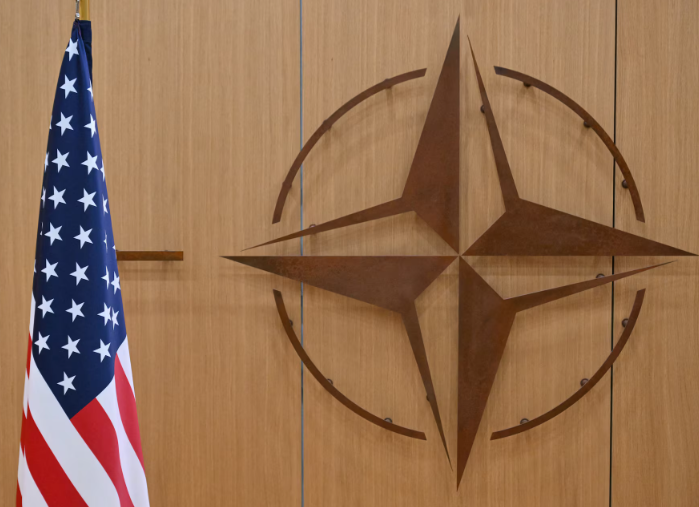
For decades, Europe built its post Cold War security architecture around one central assumption: that the United States would remain the permanent military backbone of NATO. That assumption is now visibly eroding. Reports emerging from Brussels suggest Washington has informed its European allies that it plans to sharply reduce key military contributions to the alliance, including fighter jets, strategic bombers, warships, submarines, and drones. The message delivered by senior Pentagon adviser Alexander Velez Green during a confidential NATO meeting was not merely about budget adjustments or force restructuring. It was a strategic warning that Europe must prepare for an era in which American military attention is no longer centred on the continent.
According to reports, the United States intends to cut the number of fighter jets available to NATO by nearly one third while significantly reducing naval and strategic air assets assigned to the alliance’s rapid deployment structure known as the NATO Force Model. More strikingly, Washington reportedly informed European members that no American submarines or drones would be allocated to the force structure going forward, forcing European states to provide those capabilities themselves. The announcement reportedly stunned several NATO officials who had expected gradual adjustments rather than a rapid recalibration.
The shift reflects a deeper transformation underway inside American strategic thinking. For years, US defence planners have argued that Washington’s overwhelming military commitment to Europe was becoming increasingly incompatible with the realities of a multipolar world. China’s military rise in the Indo Pacific, instability in West Asia, and growing geopolitical competition across maritime trade corridors have forced the Pentagon to rethink global force distribution. The result is a slow but unmistakable American pivot away from Europe.
US Secretary of State Marco Rubio reinforced this direction during a recent NATO foreign ministers’ meeting in Sweden, openly acknowledging that there would eventually be fewer US troops stationed in Europe. Rubio framed the decision as a strategic necessity rather than a political punishment, arguing that Washington must preserve the ability to fight a potential “two front conflict” while maintaining obligations in the Indo Pacific, West Asia, and the Western Hemisphere. Yet despite such assurances, few in Europe believe these decisions are entirely divorced from politics.
President Donald Trump has repeatedly politicised America’s military presence inside NATO. His administration has reportedly developed an informal “naughty and nice” framework that evaluates alliance members based on defence spending levels and political alignment with Washington’s priorities. Earlier this month, Trump announced the withdrawal of approximately 5,000 US troops from Germany following tensions with German Chancellor Friedrich Merz, while simultaneously promising additional troop deployments to Poland after the election victory of conservative President Karol Nawrocki. The symbolism was difficult to ignore. Military deployments are increasingly being used not just as instruments of deterrence, but as tools of political signalling inside the alliance itself.
This evolving American posture exposes a reality European leaders have long tried to avoid confronting. NATO’s military credibility still depends overwhelmingly on US logistical networks, intelligence systems, missile defence architecture, naval reach, and nuclear deterrence. European states possess advanced militaries individually, but collectively they still lack the integrated strategic depth required to independently sustain large scale continental defence without Washington’s full backing.
The timing of this American recalibration could hardly be more uncomfortable for Europe. The war in Ukraine continues to drain European military stockpiles while Russia’s defence industry has adapted to long term wartime production. European governments are simultaneously dealing with inflationary pressures, industrial competitiveness concerns, energy transition costs, and rising domestic political fragmentation. Calls for “strategic autonomy” inside the European Union now collide with the harsh realities of defence manufacturing gaps and limited fiscal flexibility.
Recent discussions inside Brussels suggest European officials are scrambling to accelerate joint procurement mechanisms, expand ammunition production, and develop independent drone and missile capabilities. Countries such as Poland and the Baltic states have sharply increased defence spending, while France continues to push for greater European strategic sovereignty. Yet progress remains uneven. Germany’s ambitious post Ukraine military modernisation programme has faced bureaucratic delays, while southern European states remain more cautious about dramatically expanding military budgets.
At the heart of this debate lies a larger geopolitical question: can NATO remain strategically coherent if America increasingly views Europe as a secondary theatre? Washington’s military doctrine is now increasingly shaped by the possibility of confrontation with China over Taiwan and Indo Pacific sea lanes. Pentagon planners understand that any major conflict with Beijing would require enormous naval, cyber, space, and air assets. In that scenario, Europe risks becoming strategically peripheral rather than central.
Ironically, the very alliance created to preserve transatlantic unity may now be entering its most politically uncertain phase since the end of the Cold War. European leaders still publicly affirm confidence in NATO, but private concerns are clearly growing. The prospect of reduced American military guarantees forces Europe to reconsider not only its defence posture, but also its broader geopolitical identity.
The debate is no longer about whether the United States is pivoting away from Europe. That pivot is already happening. The real question is whether Europe can adapt quickly enough before the strategic vacuum becomes visible to its adversaries.