

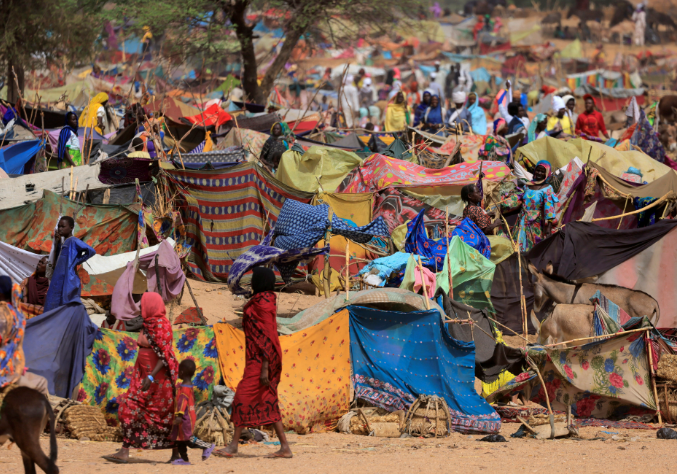
For more than two decades, refugee camps in eastern Chad have quietly absorbed the fallout of wars next door. Now they are beginning to crack under a different kind of pressure, one that does not arrive with gunfire but with silence. Funding is drying up, and with it, the fragile systems that keep more than a million displaced people alive.
The latest wave came from Sudan, where civil war since 2023 has driven hundreds of thousands across a porous desert border. By 2025, over 850,000 Sudanese had fled into Chad, joining older refugee populations from earlier conflicts. Entire settlements have formed in places where there are no paved roads, no reliable infrastructure, and increasingly, no guarantee of aid.
The distance between survival and collapse here is measured in litres of water. In some camps, people are surviving on barely 7 litres per day, less than half of what the World Health Organization considers the minimum for basic human needs. Water often comes from shallow pits exposed to contamination. In these conditions, disease does not spread, it accelerates. Cholera outbreaks in 2025 exposed just how thin the line has become. Clinics reported hundreds of cases within weeks. In overcrowded camps, a single failure in sanitation can turn into a mass casualty event.
What has changed is not just the scale of displacement, but the global willingness to pay for it. Around a decade ago, humanitarian funding was rising. Today, it is shrinking while needs are exploding. The world now has over 117 million displaced people, yet funding has stagnated at roughly 20 billion dollars annually. In real terms, that means less help for more people.
The cuts are not coming from one place. The United States, traditionally the largest donor through programmes like USAID, has scaled back foreign aid commitments. European countries are following a similar path. Germany, once among the top humanitarian donors, reduced its aid budget sharply by 2025, citing domestic financial pressures. Across the board, governments are prioritising internal spending over external crises.
On paper, these are budget decisions. On the ground, they translate into closed schools, empty food warehouses, and silent water pumps.
Education is one of the first casualties. Hundreds of thousands of refugee children in Chad are now at risk of losing access to schooling. Teachers are leaving because they are not being paid. Some earn as little as 90 euros a month, often with months of delays. Without teachers, classrooms become tents with no purpose. For children who have already fled war, this is not just a disruption, it is the erasure of any long term future.
Food security is moving in the same direction. The World Food Programme has warned that supply pipelines are thinning dangerously. In some camps, food stocks are projected to last just one or two months. Families already report going weeks without proper rations. Malnutrition is rising quietly, without headlines, but with predictable consequences.
Aid agencies themselves are shrinking. The UNHCR has cut thousands of jobs globally. Field teams that once monitored water systems, sanitation, and camp logistics are being reduced or eliminated. The result is a feedback loop. Fewer workers mean weaker systems, which increases the risk of collapse, which in turn demands more resources that no longer exist.
There is also a political layer that is becoming harder to ignore. Chad, one of the poorest countries in the world, is being asked to absorb a crisis it cannot afford. Its borders remain open, but capacity has limits. Local communities are already under strain, competing with refugees for water, land, and food. Tensions are rising, and without intervention, they risk turning into conflict themselves.
At the same time, global powers are quietly positioning themselves. China is expanding its footprint through infrastructure and investment. Russia is increasing its presence across the Sahel. Western disengagement is not creating a vacuum, it is shifting influence.
There is also a strategic consequence that policymakers are aware of but reluctant to state openly. If conditions in camps deteriorate beyond a certain point, people will move again. Not back home, where war continues, but outward. Towards North Africa, and eventually towards Europe. The migration crisis of the 2010s is still fresh in political memory. Many experts argue that cutting aid now will cost far more later, both financially and politically.
There are attempts to find alternatives. Projects aimed at self reliance, such as small scale farming initiatives, are showing some results. Refugees and local residents are being given land, tools, and training to produce their own food. These programmes reduce dependency and offer a degree of stability. But they require upfront investment, and that is exactly what is disappearing.
Meanwhile, the war in Sudan shows no sign of ending. In fact, forecasts suggest further displacement, with tens of thousands more expected to cross into Chad. Each new arrival adds pressure to a system already stretched beyond its limits.
What is unfolding in eastern Chad is not sudden, and that is precisely why it is dangerous. There is no single moment of collapse, no dramatic turning point. Instead, there is a slow erosion. A school closes here. A water pump fails there. A food shipment does not arrive. Over time, these small failures begin to connect.
By the end of 2025, cholera outbreaks had been contained, but the underlying conditions remained unchanged. Water is still scarce. Funding is still falling. Aid workers continue to leave, not because the crisis is over, but because there is no money left to pay them.
The reality is simple. Humanitarian systems are being asked to manage record levels of displacement with shrinking resources. That equation does not balance. It breaks.
And when it does, the consequences will not stay in eastern Chad.