

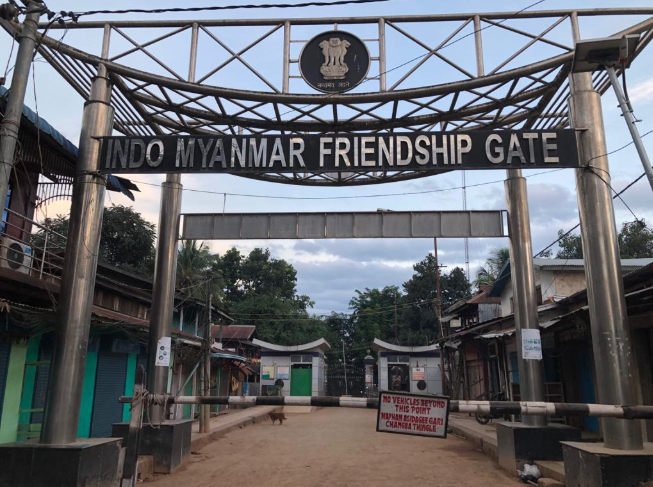
India’s grand ambition to carve a land bridge into Southeast Asia was supposed to mark a bold shift: from a navy dependent player huddled behind the Indian Ocean to a confident continental connector capable of projecting real power eastward. Projects like the India-Myanmar-Thailand Trilateral Highway were not just about trucks and trade. They were meant to puncture China’s expanding shadow across the region. At the rotten core of this vision sits Manipur, a state that has long ceased being a mere domestic headache. It has become the strategic hinge whose repeated collapse is actively sabotaging India’s eastward dreams and exposing the hollow core of its regional strategy.
Geography does not lie, and it is merciless here. The scruffy border town of Moreh in Manipur remains India’s primary land gateway into Myanmar and, in theory, onward to Thailand and the rest of Southeast Asia. Every overland corridor, every logistics chain, every hopeful calculation about road transit funnels through this narrow, volatile stretch. When ethnic bloodletting drags on for years as it has since the Meitei-Kuki-Zo clashes exploded in May 2023, movement does not just slow down. It dies. Moreh has turned into a virtual ghost town: shuttered shops, abandoned markets, residents fleeing, and legitimate border trade reduced to a trickle while smuggling thrives. A corridor that cannot guarantee basic security is not a corridor; it is a liability. India’s Southeast Asia road ambitions now sit in a permanent state of paralysis, not because of external sabotage, but because Delhi cannot stabilize its own backyard.
This vacuum is not happening in a quiet corner. While India fumbles, China’s Belt and Road Initiative keeps grinding forward with ruthless efficiency. The China Myanmar Economic Corridor ports at Kyaukphyu, oil and gas pipelines, rail links, special economic zones has deepened Beijing’s grip despite Myanmar’s civil war. Chinese projects face disruptions too, but they adapt, renegotiate, and push on. India’s flagship highway, announced years ago with much fanfare, was once slated for early completion; today officials mumble about two to three more years at best, with the critical Myanmar stretches stalled indefinitely by junta chaos and Indian side instability. The contrast screams failure: one power delivers predictable infrastructure and influence; the other watches its gateway burn while issuing optimistic press releases. Regional partners notice. They bet on reliability, not rhetoric. Right now, India’s eastern flank broadcasts only hesitation and dysfunction.
The mess grows uglier through Myanmar’s endless civil war. Fragmented control has turned the border into a smugglers’ paradise for arms, drugs, and now advanced technology. Weapons looted from junta stockpiles, including drones and components routed through porous crossings, have already bled into Manipur’s conflict. Reports of drone drops in ethnic clashes, training networks linking Myanmar rebels with Northeast insurgents, and foreign facilitators even Europeans and Americans caught in NIA probes moving tech via Indian territory paint a grim picture. China plays the field pragmatically arming, funding, or hedging with multiple factions to lock down resources, rare earths, and strategic access. India, meanwhile, watches spillover risks creep closer to its own territory while its internal security forces play whack a mole across buffer zones that have effectively partitioned Manipur for years.
The most damning part is the response or the chronic lack of one. Three plus years of violence: over 250 to 300 dead, 60,000 displaced, churches and homes torched, an economy gutted. Manipur lost hundreds of crores in revenue, exports crashed. President’s Rule came late, after a chief minister’s resignation amid accusations of bias and failure. Central intervention brought some disarmament drives and relief, but underlying hatreds over land, ST status, political power remain unresolved. Fresh clashes, protests, highway blockades, and attacks on infrastructure continue into 2026. The perception in the Northeast and beyond is brutal: the Centre lacks decisive urgency. Whether paralyzed by ethnic complexity, electoral calculations, or fear of opening a second front while staring down China in the Himalayas, the result is the same. Prolonged dithering signals weakness. In geopolitics, hesitation in a vital corridor is not caution it is surrender by attrition. It hands rivals gains without them firing a shot.
India’s Act East Policy was sold as a game changer. It now looks like a credibility shredder. Southeast Asian nations are not impressed by PowerPoint presentations or ribbon cuttings in Delhi; they watch what India can actually sustain on the ground. A disrupted, insecure corridor makes New Delhi look like an unreliable partner at best, a paper tiger at worst. China, by contrast, keeps embedding itself deeper securing minerals in Myanmar, tightening supply chains, expanding influence across fractured actors. The longer Manipur bleeds, the more the regional balance tilts quietly but decisively toward Beijing.
This is no longer a temporary setback. It is a slow motion strategic defeat. India is not waving a white flag, but it is allowing conditions that erode its position day by day: internal ethnic war, endless project delays, porous borders leaking threats, and a glaring inability to impose order. External ambition has run far ahead of internal cohesion, and the gap is widening into an abyss. What was meant to counter Chinese dominance is instead becoming a textbook case of how a rising power can undermine itself through domestic paralysis that invites rivals to consolidate without direct confrontation.
If this festers much longer, the costs will metastasize far beyond Manipur’s hills. Trade routes will stay choked, strategic outreach to ASEAN will stall, security pressures on the eastern frontier will intensify with more arms, drones, and insurgents flowing in. China’s networks will look even more attractive by simple default. The painful truth: grand geopolitical visions mean nothing if you cannot secure the first hundred kilometers out of your own territory. Manipur is not just a domestic crisis anymore. It is a brutal test of whether India can translate intent into enduring influence or whether chronic delays, political timidity, and failure to master its own fractures will let rivals reshape the map while Delhi watches helplessly.