

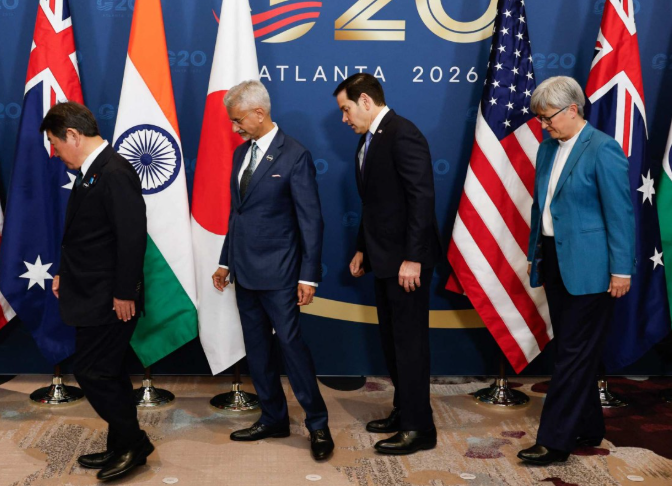
The Quad is facing a serious test of political confidence at a time when China’s influence across the Indo-Pacific continues to expand. The four-nation grouping of the United States, India, Japan and Australia was revived to strengthen regional cooperation and respond to the strategic challenges posed by Beijing. Yet President Donald Trump’s approach towards the other three members has raised doubts about Washington’s commitment to the partnership. Trade disputes, diplomatic friction and limited presidential engagement have weakened the confidence that once supported the grouping. Although cooperation continues at the ministerial and working levels, the absence of strong leadership from the White House threatens to reduce the Quad’s strategic relevance.
The concern is not that the grouping is about to disappear formally. Rather, it risks becoming an institution whose meetings continue while its political influence gradually declines. The Quad was never designed as a conventional military alliance with binding collective defence obligations. Its effectiveness depends on the willingness of its members to coordinate policies, develop shared initiatives and demonstrate that they can respond collectively to regional challenges. Without sustained political backing from their leaders, these objectives become difficult to achieve.
Established in 2007, the Quad initially struggled to maintain momentum. Internal disagreements and concerns about provoking China contributed to its inactivity the following year. The first Trump administration revived the grouping in 2017 as concerns grew over China’s economic, diplomatic and military expansion in the Indo-Pacific. However, Trump did not convene a leaders’ summit during his first term. It was under President Joe Biden that the Quad received greater political attention, with six leaders’ meetings, including two virtual gatherings. Biden hosted the last summit in Delaware in 2024.
The contrast between the two administrations has become increasingly significant. Biden treated the Quad as an important element of American engagement in the Indo-Pacific, whereas Trump has largely left its political direction to Secretary of State Marco Rubio. This has not brought the group’s activities to a complete halt. Rubio has convened meetings with the foreign ministers of the four countries, and diplomatic discussions have produced initiatives concerning energy supply chains, port infrastructure in Fiji and the integration of surveillance capabilities. These efforts demonstrate that the partnership retains practical value. However, ministerial engagement cannot fully substitute for the involvement of national leaders, particularly when the grouping is expected to address major strategic challenges.
The planned meeting between Trump and the leaders of India, Japan and Australia on the sidelines of the ASEAN summit in the Philippines therefore carries considerable importance. It would be the first Quad leaders’ meeting of Trump’s second presidency and an opportunity to restore confidence in the grouping. Yet the meeting itself will not resolve the underlying concerns. The other three members want to see consistent engagement and a willingness from Washington to treat the partnership as a strategic priority rather than an arrangement that can be activated when convenient.
Trump’s broader approach to international partnerships has contributed to this uncertainty. His administration has withdrawn the United States from international institutions and agreements, questioned the value of multilateral cooperation and repeatedly threatened to reconsider America’s commitment to NATO. This pattern has reinforced concerns that Washington’s foreign policy is increasingly driven by immediate national interests and transactional calculations. For the Quad, such an approach creates a particular problem because its members depend on political trust and long-term coordination rather than formal alliance obligations.
The most visible source of friction has been Trump’s trade policy. India faced tariffs of up to 50 percent after trade negotiations collapsed in 2025, damaging relations and contributing to the postponement of a planned Quad summit in New Delhi. Although the tariffs were reduced to 18 percent in February 2026, the dispute exposed the difficulties of maintaining strategic cooperation amid economic confrontation. Japan was also required to make a substantial investment commitment in the United States as part of arrangements for lower tariffs on automobiles and other products. Australian imports, many of which had previously entered the American market tariff-free under the bilateral trade agreement, also faced new levies.
These measures have created an uncomfortable contradiction. The Quad is intended to strengthen economic resilience and reduce the vulnerabilities that China could exploit through trade and supply chain dependencies. Yet Washington’s own tariff measures have placed additional pressure on the economies of its partners. The issue is not simply the immediate financial impact. It is the uncertainty created when countries expected to coordinate strategically are treated as targets in trade negotiations. Such policies make it harder for their governments to build domestic support for closer cooperation with the United States.
Australia has faced additional diplomatic pressure over its reluctance to send naval forces to support American operations to reopen the Strait of Hormuz. Trump has publicly criticised Canberra, while his treatment of former Australian ambassador Kevin Rudd during an Oval Office meeting further strained relations. Rudd’s early departure from the post in January added to the discomfort. These incidents have raised questions about the respect Washington extends to a country that remains an important security partner. Australia has strong reasons to maintain its relationship with the United States, but that relationship cannot be sustained indefinitely through demands for automatic political and military alignment.
India’s relationship with Washington has also become more complicated. The earlier personal warmth between Trump and Prime Minister Narendra Modi has given way to tensions arising from trade measures and wider policy disagreements. For New Delhi, the tariff dispute was particularly damaging because it challenged the assumption that closer strategic engagement would be accompanied by more predictable economic relations. India has consistently maintained its strategic autonomy and is unlikely to accept a partnership that limits its freedom to make independent decisions. Its participation in the Quad is based on shared interests in regional stability, not an obligation to follow Washington’s positions on every issue.
Japan, meanwhile, has been concerned by what it sees as Washington’s muted response to China’s economic pressure. Beijing’s measures have affected Japanese tourism, restricted rare earth exports and placed numerous Japanese companies under export control scrutiny. These actions have consequences for Japan’s economy and its industrial security. Tokyo naturally expects the United States to provide diplomatic support when a close partner faces economic coercion from China. Trump’s silence has therefore raised doubts about the practical value of American leadership within the Quad. If Washington is reluctant to speak up for Japan during a period of pressure, Tokyo has reason to question how far its strategic commitments will extend.
The consequences are not limited to bilateral relations. The Quad’s ability to develop a stronger regional security role depends on whether its members believe they can rely on one another. Cooperation on maritime security, coast guard activities, naval exercises and surveillance capabilities requires more than technical coordination. It also requires political confidence that shared initiatives will receive support when regional tensions rise. The absence of clear leadership from Washington could weaken efforts to move the grouping beyond diplomatic discussions towards more substantial security cooperation.
For China, these divisions create an opportunity. Beijing has repeatedly criticised the Quad, portraying it as an attempt to contain its rise and describing it as an Indo-Pacific version of NATO. The four members have rejected that characterisation and maintain that their cooperation is intended to support a free and open Indo-Pacific. Nevertheless, a divided Quad would make it easier for China to pursue its regional interests without facing coordinated diplomatic resistance. Beijing does not need the grouping to collapse. Uncertainty among its members and a reduced willingness to act together would already limit its effectiveness.
The other three members are consequently strengthening their cooperation through arrangements that do not depend on American participation. India and Japan held joint military exercises in September that included the first deployment of Japanese fighter aircraft into Indian airspace since the Second World War. Japan and Australia signed an agreement in August allowing Japan to test hypersonic missiles in Australia. The following week, the defence ministers of Japan, Australia and Indonesia held their first trilateral meeting on military cooperation. These developments indicate that regional partners are expanding their security relationships while maintaining the Quad as one part of a wider network.
Such cooperation does not amount to an attempt to exclude the United States. India, Japan and Australia continue to recognise the importance of American military and strategic influence in the Indo-Pacific. However, they are also demonstrating that their regional security interests cannot remain dependent on the political priorities of one administration. If Washington does not provide consistent leadership, the other members will naturally seek additional arrangements to protect their interests and strengthen their collective capacity.
There is also a wider political calculation behind their approach. Trump is entering the later phase of his presidency, and officials in Tokyo, Canberra and New Delhi are already considering whether a future administration might give the Quad greater attention. This expectation reflects the belief that the grouping retains long-term strategic value, even if its present political momentum has weakened. Yet relying on a future change of administration is not a substitute for addressing the current problems. The damage to confidence can deepen if the partners spend the remaining period waiting for Washington to reconsider its priorities.
The upcoming leaders’ meeting therefore offers an important opportunity to establish whether the Quad can regain its momentum. A meaningful outcome would require more than public assurances about friendship and cooperation. The four governments need to demonstrate that their economic and security interests can be pursued through sustained coordination. Washington, in particular, must recognise that trade pressure against its partners and limited support when they face Chinese coercion undermine the very cooperation it expects them to maintain.
The Quad is not yet beyond repair. Its members continue to share important concerns about the balance of power in the Indo-Pacific, and ongoing diplomatic and defence initiatives show that the grouping remains relevant. But its future cannot be secured through meetings alone. The United States helped revive the Quad in response to China’s growing influence. It now faces the risk of weakening that achievement through inconsistent engagement and a transactional approach towards its closest regional partners.
Ultimately, the grouping’s credibility will depend on whether Washington can demonstrate that its commitment extends beyond immediate political and economic calculations. India, Japan and Australia are unlikely to abandon cooperation with the United States, but they are already preparing to protect their interests through other regional partnerships. If that trend accelerates, the Quad may continue to exist while losing the strategic influence it was intended to provide. The greatest advantage for Beijing would not be the formal end of the grouping, but the gradual emergence of a Quad whose members no longer expect Washington to lead.