

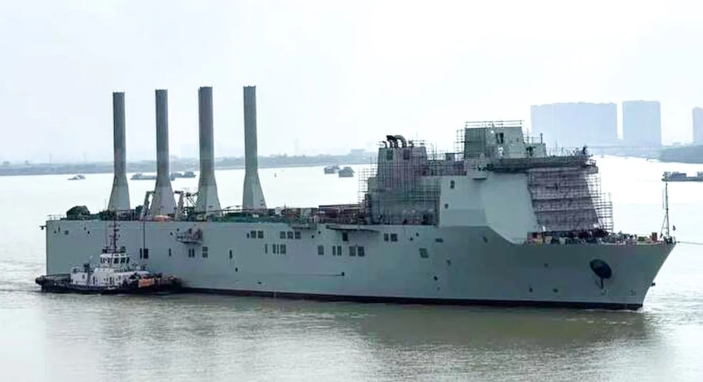
China’s naval modernisation is increasingly moving beyond the traditional competition to build larger warships, more capable submarines and longer range missiles. A less visible but potentially consequential contest is developing beneath the surface, where uncrewed underwater vehicles could transform maritime surveillance, seabed intelligence gathering and the ability to operate in contested waters. The appearance of a second unusual Chinese vessel, apparently configured to handle large underwater drones, raises an important strategic question: is Beijing moving from experimenting with very large uncrewed submarines towards building the supporting infrastructure needed to deploy them over greater distances?
The latest publicly available imagery, reported on 18 and 19 October, shows a vessel approximately 150 metres long being towed along the Pearl River near Guangzhou. Its stern contains six prominent vertical structures, alongside a large opening and a hangar like internal space. These features resemble, although do not exactly replicate, those of a much larger vessel exceeding 200 metres that was observed under construction in Shanghai and has since been launched. The larger ship features twelve vertical structures at the stern. Naval observers believe these arrangements could support a cradle mechanism for lowering large underwater vehicles into the sea and recovering them after operations. However, neither vessel’s intended role has been officially confirmed, and the footage of the Guangzhou ship has not been conclusively authenticated.
The distinction between an unusual ship and a confirmed military capability is important. The available evidence supports the assessment that China may be developing specialised platforms for very large uncrewed underwater vehicles, but it does not establish that both vessels are operational drone motherships or that Beijing has committed to building a fleet of them. The Guangzhou vessel remains unfinished, with scaffolding still visible and sensor and communications equipment apparently absent. Neither ship has been publicly observed launching or recovering an underwater drone. The strategic significance therefore lies not in treating the suspected mission as an established fact, but in examining what these vessels could enable if their apparent configuration reflects their intended purpose.
The potential importance of these ships becomes clearer when viewed alongside reports of China testing exceptionally large uncrewed underwater vehicles. Open source imagery assessments have identified possible prototypes measuring approximately 35 to 45 metres in length. If these estimates are accurate, such vehicles would be substantially larger than the autonomous underwater systems commonly used for scientific research, mine countermeasures and routine military surveillance. Their size could allow greater endurance, larger payloads and more sophisticated onboard systems, although actual range, autonomy, payload capacity and mission profiles remain unconfirmed. The suspected motherships could provide the transport, handling, maintenance and recovery facilities needed to turn these experimental vehicles into a more sustainable operational capability.
This is where the strategic calculation changes. A very large underwater drone operating independently from a coastal base faces practical limitations in transportation, deployment, recovery and maintenance. A specialised support ship could carry such a vehicle towards a distant operating area, release it, recover it after a mission and prepare it for another deployment. This would reduce the need to operate exclusively from fixed coastal facilities and could extend the geographical reach of China’s undersea operations. The mothership would not necessarily need to enter the most dangerous waters itself. It could position its underwater systems at a distance, allowing the uncrewed vehicles to undertake missions while the support vessel remains in a comparatively safer operating area.
The military applications could extend well beyond conventional reconnaissance. Large uncrewed underwater vehicles could potentially collect oceanographic data, map the seabed, monitor underwater infrastructure and improve understanding of submarine operating environments. Depending on their eventual configuration, they could also support mine warfare, electronic or acoustic intelligence collection and other specialised missions. Some future designs might carry additional military payloads, but there is insufficient evidence to conclude that the two suspected motherships are intended to support armed underwater drones. Their most immediate strategic significance may instead lie in the ability to collect information persistently in maritime areas where access by conventional platforms is politically sensitive or operationally risky.
Seabed knowledge has particular importance in the western Pacific. The waters around Taiwan, the approaches to the first island chain and the wider maritime environment contain routes that are central to submarine operations and regional military planning. Detailed knowledge of underwater terrain, acoustic conditions, currents and infrastructure can improve the effectiveness of surveillance and anti submarine warfare. It can also help a navy understand the operating environment in which its own submarines would have to function during a crisis. If China develops a reliable system for deploying large underwater drones over extended distances, the resulting information advantage could strengthen its ability to monitor maritime movements and complicate the planning of rival navies.
For Taiwan, the concern would not necessarily be an immediate underwater attack. It would be the possibility that China could improve its persistent surveillance of surrounding waters, gather detailed information about maritime approaches and expand the range of missions performed without placing crewed submarines at risk. For the United States and its regional partners, a more extensive Chinese uncrewed underwater capability could complicate submarine operations, maritime surveillance and the protection of undersea infrastructure. These are potential implications rather than confirmed operational outcomes. Their seriousness would depend on the vehicles’ endurance, sensors, communications, navigational accuracy and ability to operate reliably in difficult underwater conditions.
The appearance of two differently configured vessels also raises questions about the scale and maturity of China’s ambitions. The Shanghai ship is considerably larger and features twelve stern structures, while the Guangzhou vessel appears to be closer to 150 metres long and has six. These differences could reflect separate operational requirements, different payload capacities or variations within a developing family of support ships. They could also indicate that Chinese shipbuilders are testing alternative arrangements rather than following a settled production design. The evidence does not yet establish a standardised fleet programme. Nevertheless, the appearance of a second potentially related vessel suggests that the underlying concept merits closer attention than a single experimental hull would warrant.
China’s shipbuilding infrastructure adds another dimension to the assessment. Its major shipyards can construct a broad range of naval combatants, amphibious vessels, replenishment ships and specialised auxiliaries. This industrial capacity could allow Beijing to refine an experimental design, adapt it for different missions and potentially produce additional support vessels if operational trials justify the investment. The strategic advantage would come not simply from building a large underwater drone, but from creating an integrated system that includes the vehicle, its support ship, command arrangements, maintenance facilities and the data infrastructure needed to exploit what it collects. The ability to reproduce and sustain that system would matter more than the number of unusual hulls visible in satellite imagery.
However, a mothership is not invulnerable merely because the vehicles it deploys are uncrewed. A vessel of this size would remain visible to maritime surveillance and could be vulnerable to aircraft, submarines, missiles and other forces in a high intensity conflict. Its operational value would depend on its ability to reach deployment areas without being detected or attacked, maintain reliable communications where possible and recover its vehicles under challenging sea conditions. Underwater drones themselves also face substantial technical obstacles, including navigation without continuous satellite positioning, communication through water, battery endurance, sensor reliability and the difficulty of recovering a large vehicle in rough seas. A support ship can mitigate some of these limitations, but it cannot eliminate them.
These constraints may shape how China ultimately employs such vessels. Rather than sending them deep into heavily contested waters during the opening stages of a major conflict, the navy might use them for surveillance, seabed mapping and other missions in comparatively permissive environments, or position them where their vehicles can operate at greater distances from the mothership. They could also serve as experimental platforms through which the People’s Liberation Army Navy develops operating procedures before deciding whether to invest in a wider force. In that sense, the ships could be valuable even before they become central elements of wartime operations, because they provide a means to test the practical requirements of large uncrewed submarines.
For the United States and other maritime powers, the development highlights the need to look beyond the visible balance of surface ships and crewed submarines. Future naval competition will increasingly depend on the ability to combine crewed platforms with autonomous systems, underwater sensors, seabed intelligence and resilient command networks. Monitoring the construction of suspected motherships is only one part of that assessment. More revealing evidence would include the appearance of operational support equipment, the identification of the vessels’ operators, confirmed launch and recovery trials, repeated deployments and indications of a sustained production programme. Until such evidence emerges, claims that China is already fielding a fleet of underwater drone motherships should be treated cautiously.
The broader strategic issue is that uncrewed underwater systems could gradually alter the relationship between naval presence and geographical reach. A navy may not need to send a conventional submarine into every area it wishes to monitor if it can deploy autonomous vehicles that collect information over extended periods and return it through a support network. Such systems would not replace crewed submarines, which retain advantages in judgement, flexibility and complex operations. They could, however, supplement them by expanding surveillance coverage, reducing some risks to personnel and forcing adversaries to devote additional resources to detecting and countering underwater threats.
The appearance of the Guangzhou vessel alongside its larger Shanghai counterpart does not yet prove that China has established a new class of operational naval capability. It does, however, raise the possibility that Beijing is exploring the infrastructure required to move very large underwater drones from experimental projects towards more sustained maritime operations. If confirmed, the strategic importance of these ships would lie less in their size than in the reach, persistence and flexibility they could give the underwater systems they support. The decisive evidence will come not from the unusual appearance of their hulls, but from what China ultimately demonstrates that these vessels and their underwater vehicles can do at sea.