

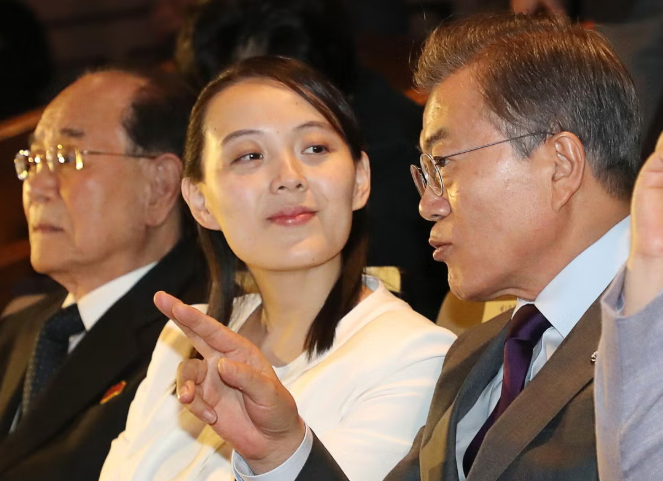
Kim Yo Jong has emerged as one of the most prominent political figures in North Korea, representing a distinctive combination of hereditary legitimacy, institutional authority and proximity to the country’s supreme leadership. Born in Pyongyang in 1987, she is the daughter of former supreme leader Kim Jong Il and Ko Yong Hui, and the younger sister of current leader Kim Jong Un. Growing up within the ruling family exposed her to the political traditions, internal hierarchies and highly controlled environment of North Korea’s governing establishment from an early age. A defining phase of her childhood occurred during the late 1990s and early 2000s, when she reportedly studied in Berne, Switzerland, alongside her brother under assumed identities. Her education abroad provided exposure to a society markedly different from the political and social environment in which she would eventually build her career. Following her return to North Korea, she remained largely outside public attention for several years before gradually entering the political establishment. Her subsequent advancement demonstrated how a relatively private member of the ruling family developed into a recognised figure within the country’s highest political institutions.
Her rise within the Workers’ Party of Korea reflects a progression through positions associated with ideological communication, party administration and senior leadership responsibilities. She initially became prominent through her involvement in the Central Committee’s Propaganda and Agitation Department, where she acquired responsibilities connected with the presentation of the ruling leadership and the management of official political messaging. In 2017, she became an alternate member of the Politburo, marking an important step in her institutional advancement. Although she subsequently lost that position at the Eighth Party Congress in 2021, her influence within the leadership remained evident through her continued public engagements and official responsibilities. Her position was further strengthened at the Ninth Party Congress in February 2026, when she was promoted to department director of the Central Committee and reinstated as an alternate member of the Politburo. On 28 February 2026, North Korean state media identified her as Director of the General Affairs Department of the Workers’ Party of Korea. The appointment represented a significant development in her career, placing her in charge of an important administrative department associated with party documentation, organisational coordination and internal operations. Her advancement illustrates the growing institutional dimension of her political position beyond her original association with propaganda and public communication.
Her international public profile expanded considerably in February 2018, when she travelled to South Korea as a special envoy of Kim Jong Un during the PyeongChang Winter Olympics. Her visit was historically significant, making her the first member of the ruling Kim family to travel to South Korea since the Korean War. She met President Moon Jae-in and delivered a personal invitation from her brother for an inter-Korean summit, contributing to the diplomatic opening that followed. She subsequently accompanied Kim Jong Un during several important diplomatic engagements, including the Singapore summit with US President Donald Trump in June 2018 and the Hanoi summit in February 2019. Her presence at these meetings demonstrated her access to sensitive diplomatic proceedings and her position within the leader’s immediate political circle. Beyond accompanying her brother, she became an increasingly visible participant in official engagements, interacting with foreign dignitaries and representing the North Korean leadership at events requiring both political sensitivity and diplomatic protocol. These experiences established her as a recognisable figure in international diplomacy and distinguished her from conventional party officials whose responsibilities rarely extend to such high-profile engagements.
One of the most recognisable aspects of her political career is her role in North Korea’s official communication apparatus. Her statements, frequently issued through the Korean Central News Agency, address sensitive political developments and carry the authority associated with her position within the ruling establishment. Since 2020, she has increasingly issued direct public responses concerning South Korea’s policies, joint military exercises, inter-Korean relations and statements by foreign governments. Her communication style is generally direct, assertive and deliberately formal, with language that frequently distinguishes between political criticism and official warnings. Unlike spokespersons who communicate established positions on behalf of government departments, Kim Yo Jong’s statements attract attention because they originate from a senior member of the ruling family who also holds an institutional position within the party. This combination gives her public interventions a distinctive political character. Her earlier association with propaganda administration and subsequent promotion to department director also reflect the importance of communication-related responsibilities in her professional development.
Her working style is characterised by a notable contrast between her carefully managed diplomatic appearances and her more uncompromising public statements. During international engagements, she has generally maintained a composed and restrained presence, adhering to the formal expectations of diplomatic protocol. In official political communications, however, she has adopted a considerably more forceful tone, particularly when responding to criticism of North Korea or developments involving South Korea. This difference in presentation demonstrates her ability to adapt her public conduct to the institutional setting and the nature of the assignment. Her political persona is therefore shaped by two recognisable roles, the discreet representative who participates in high-level diplomatic engagements and the assertive official who communicates the leadership’s positions directly. Although public appearances cannot establish her private personality or psychological characteristics, her documented political conduct provides insight into her experience in managing sensitive assignments, handling public scrutiny and maintaining a consistent official presence across different political settings.
Her career also reflects a gradual transition from being primarily associated with her brother’s public activities to acquiring an identifiable position within the country’s governing institutions. Her responsibilities have included participation in official ceremonies, diplomatic representation, political communication and senior party administration. Her advancement is particularly notable because North Korea’s political establishment remains dominated by male officials, while her membership of the ruling family provides an additional source of political legitimacy. Nevertheless, her position cannot be understood exclusively through hereditary association. Her repeated appointments, continued participation in important state engagements and elevation to departmental leadership demonstrate an established record of institutional involvement. The relationship between family standing and official responsibility is central to understanding her political career, as both have contributed to her position within the ruling establishment. Her public prominence has also made her one of the relatively few North Korean officials whose statements, appointments and appearances receive sustained international attention.
Kim Yo Jong’s future political position will depend on how her responsibilities evolve within the Workers’ Party and the wider ruling establishment. Her appointment as Director of the General Affairs Department and reinstatement as an alternate member of the Politburo in 2026 have given her a more prominent institutional position than she previously held. These developments also invite attention to the future organisation of the Kim dynasty, particularly following the growing public visibility of Kim Jong Un’s daughter, Kim Ju Ae. However, speculation about succession should remain separate from an assessment of Kim Yo Jong’s established political standing. There is no publicly confirmed designation of her as the next supreme leader, and her present responsibilities do not establish such an outcome. Her significance instead rests on her existing position as a senior party official, a member of the ruling family and an experienced participant in diplomatic and administrative affairs. Whether her influence expands into additional areas of party governance or remains concentrated around her current responsibilities will become clearer through future appointments and official engagements.
Kim Yo Jong’s political journey illustrates the development of a figure whose career combines dynastic heritage with institutional advancement. From her relatively private upbringing and education abroad to her emergence in international diplomacy, political communication and senior party administration, she has acquired a distinct place within North Korea’s ruling establishment. Her significance extends beyond her relationship with Kim Jong Un, although that relationship remains fundamental to understanding her access to the highest levels of authority. Her political record demonstrates sustained involvement in the country’s official engagements, an expanding portfolio of party responsibilities and an increasingly prominent public presence. At the same time, the limited transparency of North Korea’s political system makes it difficult to establish the full extent of her independent decision-making authority. What can be established is that she is no longer simply a member of the ruling family accompanying the supreme leader. She is an established political figure with her own institutional responsibilities, a recognisable diplomatic record and a continuing role in the administration of the Workers’ Party of Korea.
Kim Yo Jong’s Quote
“Let me be clear once again that our army has its trigger already unlocked.”
7 January 2024 · Military warning to South Korea