

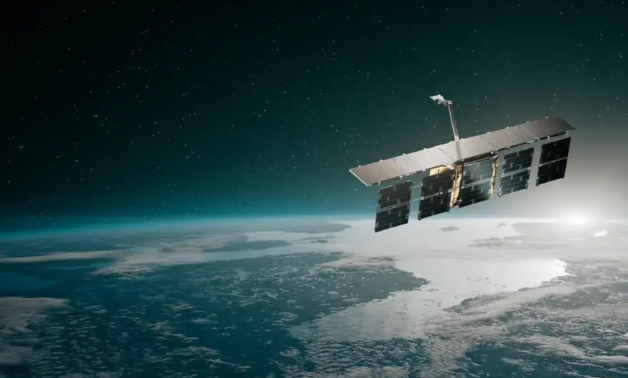
The Russia Ukraine war is no longer confined to the battlefields, the skies above Ukraine or the waters surrounding Europe. It is increasingly exposing a more distant but strategically vital arena where military advantage depends on surveillance, communications, navigation and the ability to observe an adversary without crossing its borders. The reported close approach of Russia’s Cosmos 2612 satellite to ICEYE-X36, a commercial radar imaging satellite, has brought this emerging contest into sharper focus. The incident raises a question that governments and space operators can no longer afford to ignore. What happens when the infrastructure used to support military operations becomes vulnerable to another country’s manoeuvres in orbit?
The reported encounter took place in the early hours of October 18, following a series of orbital manoeuvres by Cosmos 2612. Independent satellite tracking analysis indicated that the Russian spacecraft had adjusted its orbit over several weeks before moving into close proximity with ICEYE-X36. Some reports described the separation as approximately 100 metres, while independent orbital analysts cautioned that publicly available tracking data could not establish the precise minimum distance with confidence. The uncertainty surrounding the exact separation does not erase the significance of the approach itself. The more consequential detail is that Cosmos 2612 appeared to have deliberately altered its trajectory to operate near another active satellite. There was no confirmed evidence that ICEYE-X36 had been struck, damaged or forced off course. The incident must therefore be treated as a serious strategic warning rather than proof of an attack.
ICEYE-X36 belongs to a commercial satellite system developed by Finnish founded ICEYE, a company known for synthetic aperture radar imaging. Unlike conventional optical satellites, which depend on suitable lighting and can be hindered by cloud cover, synthetic aperture radar can collect images in darkness and through many weather conditions. This capability makes radar imagery valuable for monitoring military movements, assessing damage, observing infrastructure and tracking changes on the ground. ICEYE has provided satellite imagery capabilities to Ukraine, strengthening the role of commercial space technology in the country’s defence. However, public reporting has not established that ICEYE-X36 itself was the particular satellite supplying imagery to Ukrainian military operations at the time of the encounter. That distinction matters because strategic analysis must separate the established role of a company’s wider network from the unconfirmed operational role of an individual spacecraft.
The wider significance lies in the transformation of commercial space infrastructure into an essential component of modern warfare. Military forces increasingly rely on privately operated satellites for intelligence, communications, navigation and battlefield awareness. Commercial companies can provide capabilities that were once available primarily to major military powers, allowing states to obtain information more quickly and sometimes more affordably than through their own satellite programmes. Ukraine’s use of commercial space services illustrates how privately developed technology can influence the conduct of a conflict. But this dependence also creates a vulnerability. A satellite may be privately owned, operated by a company registered in one country, developed in another and used to support a government engaged in a war. Its commercial identity does not prevent it from acquiring strategic significance.
For Russia, the growing contribution of commercial satellite networks to Ukraine’s military awareness may be viewed as an extension of Western support beyond conventional weapons deliveries. Radar imagery can help identify changes in troop deployments, monitor logistics, assess the condition of military infrastructure and evaluate the results of strikes. Such information does not independently determine the outcome of a battle, but it can improve the quality and speed of operational decisions. A state seeking to reduce an adversary’s access to these capabilities may therefore have an incentive to study, monitor or potentially disrupt the satellites that provide them. This is a plausible strategic explanation for why a Russian military satellite might approach a commercial spacecraft associated with a company serving Ukraine. It is not, however, proof of the Russian satellite’s precise mission or of an intention to attack.
The distinction between surveillance and hostile action is central to understanding the danger. A satellite capable of changing its orbit and approaching another spacecraft may be gathering information, testing proximity operations, demonstrating technical competence or preparing for a more confrontational mission. Without reliable evidence of its payload, command objectives and operational intent, it would be premature to conclude that Cosmos 2612 was equipped to disable ICEYE-X36 or that an attack was imminent. Nevertheless, deliberate proximity operations can provide an operator with an opportunity to examine another satellite, observe its behaviour and demonstrate that it can approach an object in orbit. Even without physical contact, such manoeuvres can create uncertainty and pressure on the other operator. The strategic effect may come not only from what a spacecraft can do, but also from what its movements lead another state to fear.
This is where the incident becomes more than a technical curiosity. On Earth, the movement of military aircraft or naval vessels close to another country’s assets can serve as a signal of capability, a warning or a means of gathering intelligence. In orbit, similar actions take place in an environment where distance, velocity, orbital mechanics and limited public information complicate interpretation. A spacecraft approaching another satellite does not automatically constitute an attack, and there is no universally accepted rule requiring every satellite to maintain one fixed separation from every other spacecraft. Yet close approaches between active satellites can create collision risks, expose sensitive capabilities and intensify suspicions, particularly when the operators belong to states on opposing sides of a war.
The consequences of a collision or deliberate interference could extend well beyond the two spacecraft involved. A damaged satellite might lose its mission, generate debris or require costly replacement. In a crowded orbital environment, debris can threaten other spacecraft and complicate operations for commercial and government operators that had no connection to the original confrontation. A single incident would not necessarily produce a chain reaction, but repeated hostile encounters could gradually increase risks for the wider space environment. The financial consequences would also be substantial. Replacing a satellite involves more than manufacturing another spacecraft. Operators may have to arrange a launch, restore coverage, reconfigure services and manage the loss of data during the interruption. For a military force relying on timely intelligence, even a temporary gap could matter.
The danger is amplified by the difficulty of establishing responsibility. Satellite operators depend on tracking data to understand the movement of objects, but public orbital estimates have limitations, particularly when spacecraft conduct manoeuvres between observations. The uncertainty surrounding the closest approach between Cosmos 2612 and ICEYE-X36 demonstrates why precise claims about separation must be treated cautiously. If a satellite were later to malfunction, proving that another spacecraft caused the failure could be difficult without detailed telemetry, technical inspection or access to information controlled by the operators. A state might suspect interference while lacking the evidence necessary to establish responsibility conclusively. This creates a troubling strategic environment in which actions can generate pressure without necessarily producing a clear and publicly demonstrable violation.
The international legal framework adds another layer of complexity. The Outer Space Treaty establishes that states must conduct activities in outer space in accordance with international law and requires them to bear international responsibility for national space activities, including those carried out by non governmental entities. It also places obligations on states concerning the peaceful use of outer space and the avoidance of harmful contamination. However, the treaty does not provide a comprehensive operational code for every close approach between satellites, nor does it establish a universally binding minimum distance that spacecraft must maintain. The legal assessment of a particular encounter would depend on the circumstances, the conduct involved, the applicable obligations and the available evidence. This gap between broad legal principles and the realities of increasingly sophisticated orbital operations strengthens the case for clearer international standards on notification, transparency, collision prevention and responsible proximity manoeuvres.
The United States and its European partners now face a challenge that cannot be addressed solely through statements of concern. They need more comprehensive space situational awareness, stronger coordination between commercial operators and national security agencies, and procedures for sharing warnings when a satellite appears to be conducting an unusual approach. Commercial operators should have reliable channels for reporting suspicious activity, preserving technical evidence and coordinating responses with relevant governments. Governments, in turn, need to develop options that are proportionate to the evidence, whether through diplomatic engagement, public attribution, technical safeguards or other lawful measures. Treating every close approach as an act of aggression would risk escalating tensions unnecessarily. Ignoring repeated and carefully executed manoeuvres would be equally irresponsible.
Commercial satellite companies must also recognise that operating in a conflict affected environment brings strategic exposure alongside commercial opportunity. Resilience requires more than launching additional spacecraft. It includes designing systems that can tolerate the loss of individual satellites, distributing essential services across multiple platforms, maintaining alternative sources of intelligence and preparing for temporary interruptions. Operators should assess whether their systems can detect abnormal changes, preserve reliable records and coordinate rapidly with other providers. Governments that rely on commercial services should avoid allowing one company or one satellite to become a single point of failure in critical military or civilian operations. The objective should be to ensure that interference with one spacecraft cannot automatically deprive an entire network of its value.
For Ukraine, the issue is especially consequential because access to commercial intelligence and communications has helped offset some of the disadvantages it faces against a larger military power. Any sustained effort to intimidate or disrupt the companies providing these services could place pressure on both the battlefield and the wider network of international support. Yet the implications are not limited to Ukraine. The incident demonstrates that commercial space infrastructure can become entangled in geopolitical competition even when a particular satellite is not publicly confirmed to be performing a direct military task. The same vulnerability could confront other countries whose armed forces, emergency services, financial systems and critical infrastructure depend on privately operated satellites.
The Cosmos 2612 and ICEYE-X36 encounter illustrates how the boundaries of modern warfare are changing. The strategic contest is no longer simply about who possesses the most advanced weapons or controls the greatest territory. It is also about who can observe, communicate, navigate and maintain access to the systems that support military and civilian life. Satellites that once appeared distant from the immediate realities of war have become part of its operational infrastructure, and their vulnerability can carry consequences on the ground.
The most important lesson is not that a space attack has been proven, because the available evidence does not establish that conclusion. It is that the ability to approach another country’s commercially operated satellite has become a source of strategic leverage in its own right. If such manoeuvres become routine without clearer standards, transparency or credible mechanisms for managing risk, every unexplained orbital encounter could generate suspicion, every malfunction could become a geopolitical dispute, and every commercial satellite could be viewed through the lens of military competition. Preventing that future will require more accurate tracking, stronger safeguards, clearer international norms and disciplined political judgement. Space may be vast, but the orbital environment on which modern societies increasingly depend is neither unlimited nor immune to conflict. Protecting it is no longer merely a technical responsibility. It is an essential part of international security.