

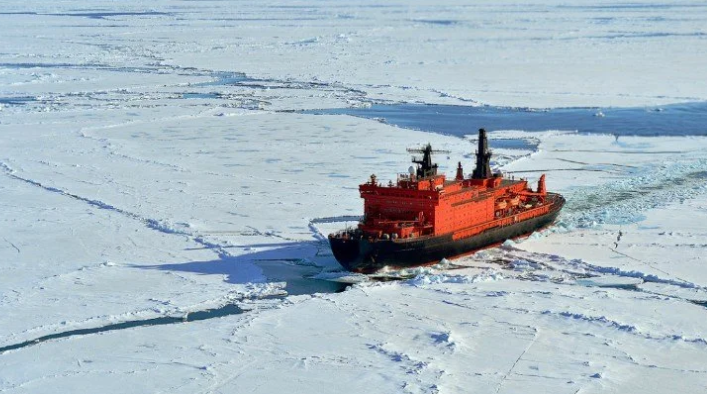
The European Union is increasingly positioning itself against the commercialisation of Arctic shipping even as China and Russia accelerate their joint push to turn the Northern Sea Route into a regular trade corridor. Europe’s caution reflects not only environmental and navigational concerns but also a deeper strategic anxiety about Beijing and Moscow consolidating a polar axis that could reshape Eurasian connectivity and weaken Western leverage over global maritime flows. As the Arctic warms at an alarming pace, the route’s promise of shorter transit times between Asia and Europe has attracted serious investment and political backing from Russia and China, while major European carriers and policymakers remain wary of legitimising Moscow’s control over a passage that runs along Russia’s Arctic coast.
Brussels has signalled that an updated EU Arctic policy is due later this year, with preparatory recommendations from the European Parliament warning that expanding Sino-Russian cooperation in energy, infrastructure and polar shipping risks cementing a geopolitical axis of resource exploitation and restricted access. The recommendations call for applying international law to counter efforts that legitimise contested shipping corridors or project geopolitical influence under the guise of scientific or economic cooperation. At the heart of the dispute is the legal status of the Northern Sea Route. Moscow invokes Article 234 of the UN Convention on the Law of the Sea, the so-called Ice Clause, to enforce strict environmental and navigational regulations over ice-covered areas in its exclusive economic zone. The EU contends that shrinking sea ice undermines Russia’s legal basis to invoke the clause and argues that Moscow’s transit restrictions and bans on foreign military vessels are discriminatory and violate the convention.
Europe’s reluctance to embrace the route is also driven by the fear that commercialising it would entrench Russian state control and development of the Arctic. Payments for permits, icebreaker assistance, pilotage and other infrastructure directly support a transport corridor operated by the Russian state and help Moscow present the Northern Sea Route as a successful international project despite its isolation from Europe. European officials stress that accepting port calls does not imply legal recognition of Russia’s authority over the route, allowing European countries to challenge Moscow’s claims under international law while still engaging pragmatically where necessary. This calibrated approach seeks to avoid handing Moscow a propaganda victory while preserving the ability to use ports, insurance, finance and environmental standards as levers of influence over vessels that use the route to reach European markets.
Against this backdrop, major European shipping companies have reaffirmed their commitment to avoid Arctic transits. Top container carriers cite environmental concerns, doubts over commercial viability and severe navigational hazards as decisive factors. Geopolitical and reputational risks are seen to outweigh the commercial incentives, especially given the route’s dependence on sanctioned Russian icebreakers and escorts. The CEO of Maersk has stated that he does not view the passage as a meaningful substitute for conventional routes, noting that it relies on sanctioned Russia to provide icebreakers and escorts throughout those waters. The head of MSC, the world’s largest container shipping company, has similarly declared that the company does not and will not use the Northern Sea Route, arguing that safe navigation cannot be assured, risks for crews remain too high and increased traffic would put additional pressure on fragile ecosystems and local communities. In 2019, four of the world’s five largest shipping companies signed a voluntary pledge not to send ships through the Arctic, a commitment that China’s Cosco Group did not join.
The environmental argument carries particular weight in European capitals. The Arctic is warming around four times faster than the rest of the world, and its ecosystems are already under intense stress. Unpredictable and at times perilous conditions make each trip hazardous, and major marine insurers have applied improved due diligence requirements for Arctic transits, mandating pre-voyage surveys and specific warranties regarding vessel suitability, crew competence and operational planning. According to global insurer Allianz Commercial, Arctic shipping presents a markedly higher risk profile than conventional trade routes, with operational risks dominating and machinery damage and failure accounting for nearly half of all reported casualties. A Russian tanker recently suffered serious hull damage while navigating through Arctic sea ice, resulting in a substantial insurance payout, underscoring that icebreaker assistance does not eliminate the physical risks associated with Arctic navigation. The remoteness of the region and the lack of infrastructure such as port state control, tug availability and repair facilities make these risks particularly acute.
While Europe hesitates, China and Russia are moving decisively to institutionalise their Arctic partnership. Beijing and Moscow have agreed to jointly develop and commercialise shipping along the Northern Sea Route, with a roadmap approved in late 2025 targeting at least twenty million tonnes of annual Russia-China cargo traffic by 2030. Chinese shipping companies made 17 container voyages along the route in 2025, and transit cargo volumes hit a record 3.2 million tonnes that year. In 2026, Rosatom announced that 7 Chinese transit vessels had been issued permits to sail to Europe via the Northern Sea Route, and Sea Legend Shipping launched the first regular container service on the corridor, with 8 sailings scheduled through October and a transit time of roughly 20 days compared with around 40 on the conventional route. Another Chinese carrier, NewNew Shipping Line, has expanded its footprint with the first delivery of containerised cargo to Murmansk via the Northern Sea Route and is targeting as many as 12 voyages between China and Arkhangelsk in 2026. Russia and China have also signed agreements to jointly develop Arctic-class vessels, train Chinese ship crews for polar operations and establish a subcommission on Northern Sea Route cooperation, embedding the corridor more deeply into the broader architecture of Sino-Russian strategic collaboration.
This deepening collaboration extends beyond shipping. Joint military drills in Arctic-adjacent areas, coastguard cooperation in the Arctic Ocean and joint projects in the mining and energy sectors have reinforced the perception in Europe that the Polar Silk Road is part of a wider geopolitical alignment. Moscow and Beijing present the route as an international public good that should be accessible to all countries, arguing that European environmental and safety standards could improve governance along the corridor rather than obstruct its development. European analysts counter that the route’s time and fuel savings are offset by high insurance premiums, the need for specialised ice-class vessels and elevated operational costs in harsh Arctic conditions, rendering the economic impact of Europe staying away from the route negligible in the near term. They also warn that commercialising the corridor could cement Russia’s control and development of the Arctic at a time when Moscow is already using energy and infrastructure ties to deepen dependence among partners seeking alternatives to Western-dominated sea lanes.
Europe’s strongest influence, however, may lie not in competing with Russia for control of the route but in the ports and commercial services needed for ships using it to reach European markets. European authorities can use sanctions screening, insurance and financial rules, as well as environmental and safety standards, to determine the conditions under which vessels using the Northern Sea Route enter European ports. This strategy is already taking shape. Denmark, joined by France, Germany and the Solomon Islands, recently submitted a proposal to the International Maritime Organization requiring ships operating in the Arctic to switch to cleaner fuels to reduce black carbon emissions. The move illustrates how Europe is using stricter environmental compliance to assert its influence over polar shipping, leveraging its regulatory power to shape the terms under which Arctic transit can access European destinations. By tightening compliance on fuel quality, emissions and safety, Europe can raise the cost and complexity of Arctic transits without directly challenging Russia’s jurisdictional claims, thereby preserving diplomatic space while still constraining the route’s commercial appeal.
The strategic stakes extend beyond trade. As the Northern Sea Route matures, it offers China a partial hedge against vulnerabilities in traditional chokepoints such as the Strait of Hormuz and the Suez Canal, while giving Russia a lever to project influence and attract partners disenchanted with Western sanctions. For Europe, the risk is that a successful Sino-Russian polar corridor could gradually reorient Eurasian logistics in ways that diminish the centrality of European hubs and norms. Yet the route’s physical and economic constraints remain formidable, and Europe’s ability to set the terms of access through its ports, insurers and regulators gives it significant indirect leverage. The coming months will test whether Brussels can translate its regulatory and environmental agenda into a coherent Arctic strategy that safeguards ecological integrity, upholds international law and prevents the Northern Sea Route from becoming a tool of geopolitical coercion, even as Moscow and Beijing press ahead with their vision of a polar silk road stitched together by icebreakers, joint ventures and shared strategic ambition.